Oversized AC: The Symptoms, Why It Happens and What to Do
Oversizing is one of the most common problems in residential HVAC, and customers often describe it as "the AC works, but the house feels sticky."
Symptoms
- Short cycles: in hot weather the system runs only a few minutes at a time, many times an hour.
- High indoor humidity even though the thermostat is satisfied: clammy air, condensation on windows or vents, musty smells.
- Uneven temperatures: rooms far from the equipment never catch up before the system shuts off.
- Noise and drafts from high airflow, sometimes paired with undersized ducts.
- More wear: frequent starts are hard on compressors, contactors and capacitors.
Why oversizing hurts humidity
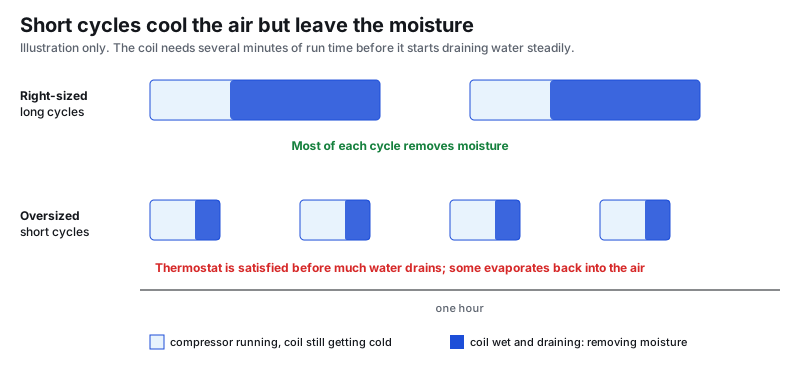
An air conditioner removes moisture only after the coil gets below the dew point and starts dripping. That takes several minutes into each cycle. An oversized system reaches setpoint before it has removed much moisture, and some water left on the coil evaporates back into the air when the blower keeps running.
Confirming it
- Watch run times on a design-condition day, and check thermostat history if it records cycles.
- Measure indoor humidity. Sustained relative humidity above about 60% is a red flag.
- Compare equipment size with a load calculation. See Manual J vs. rule of thumb.
What you can do without replacing it
- Lower cooling airflow toward about 350 CFM per ton (within the manufacturer's limits) for a colder coil and better moisture removal. See 400 CFM per ton.
- Turn on dehumidify modes on variable-speed blowers and communicating thermostats.
- Don't run the fan continuously in cooling season in humid climates. It can put moisture back into the air.
- Adjust thermostat cycle settings so the system runs fewer, longer cycles.
- Fix ducts and airflow problems so each room actually gets its air.
- Add a whole-house dehumidifier in humid climates where latent load stays high.
- At replacement: downsize based on a load calculation, or choose two-stage or variable-capacity equipment.
How oversized is "oversized"?
Manual S, the equipment selection standard that goes with Manual J, allows cooling equipment to be somewhat larger than the calculated load, with tighter limits for single-stage equipment and more room for multi-stage and variable-capacity equipment. A rule-of-thumb "one ton per 500 square feet" often lands well above that, especially in newer, tighter homes. That's why so many systems short cycle.
A quick field check
| Clue | What it suggests |
|---|---|
| Short cycles on the hottest afternoons | Likely oversized (or a thermostat placement problem) |
| Long cycles but still humid | Airflow too high, fan set to On, or duct leakage pulling in humid air |
| Long cycles and can't keep up | Undersized, low charge, dirty coil, or duct problems |
| Some rooms hot, some cold | Duct design and balancing, not equipment size |
Check the thermostat location too. A thermostat in the path of a supply register, or near a cold return, can make a correctly sized system short cycle.
The cost of oversizing
- Comfort: humid, uneven, drafty.
- Equipment life: more starts per hour means more wear on compressors, contactors and capacitors.
- Efficiency: systems lose efficiency in the first minutes of each cycle, so many short cycles waste energy.
- Ducts: a bigger system often gets connected to the same undersized ducts, raising static pressure and noise.
Common mistakes
- Replacing "like for like" without a load calculation. The old system may have been oversized too, and the house may have new windows, insulation or air sealing since then.
- Sizing up "to be safe." It usually makes comfort worse in humid climates.
- Fixing humidity by lowering the thermostat. It cools the house more without drying it much.
- Ignoring variable-capacity options. Two-stage and inverter equipment can cover a wide range of loads with long, low-speed cycles.
FAQ
Is a bigger air conditioner better?
No. A system sized to the load runs longer cycles, removes more moisture, keeps temperatures even and lasts longer.
How long should an AC run per cycle?
It depends on the load and the equipment. A properly sized single-stage system on a hot day often runs long cycles, sometimes nearly continuously at design conditions. A few minutes on, then off, over and over, suggests oversizing or another problem.
Can a variable-speed system be oversized?
Yes, but variable-capacity equipment handles it better because it can slow down and run longer at low capacity.
Sources
One field tip a week
A short, practical HVAC tip in your inbox every week: diagnostics, charging, airflow and code changes. Free, unsubscribe anytime.
We'll only use your email for the newsletter. Privacy policy.
Tools for this job
Target Superheat Calculator
Target superheat for piston and cap-tube systems from indoor wet bulb and outdoor dry bulb.
CFMFurnace Airflow from Temperature Rise
Estimate furnace CFM from input BTU, efficiency and the supply/return temperature rise.
Related guides
AC Short Cycling: Why the Compressor Turns On and Off Too Often
How to diagnose an air conditioner or heat pump that short cycles, using how long it runs and what stops it: thermostat problems, safety switches, low charge, airflow, and oversizing.
Manual J vs. Rule of Thumb: Why '500 Square Feet per Ton' Gets Sizing Wrong
Why square-feet-per-ton sizing misses, what a Manual J load calculation accounts for, and how Manuals S and D fit in.
High Indoor Humidity with the AC Running: Causes and Fixes
Why a house stays humid even with the air conditioner working, from oversizing and airflow to fan settings, duct leaks and ventilation.
Furnace Control Board Fuse Blown (3A): Finding the 24V Short
Why a furnace control's low-voltage fuse blows and how to find the short in thermostat, outdoor unit or accessory wiring before replacing it.
Field reference for trained technicians. Always follow the equipment manufacturer's instructions, local code and safe work practices. See our editorial standards, or report a correction.