Furnace Control Board Fuse Blown (3A): Finding the 24V Short
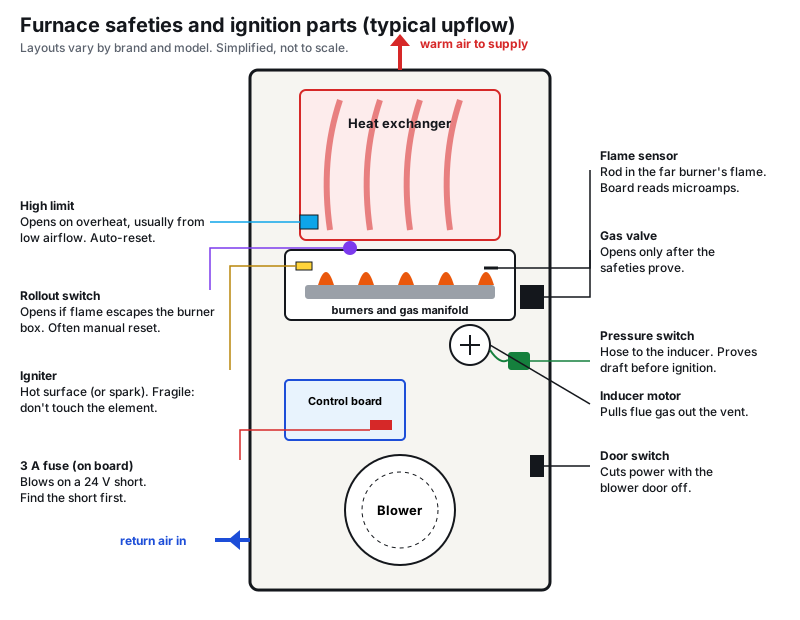
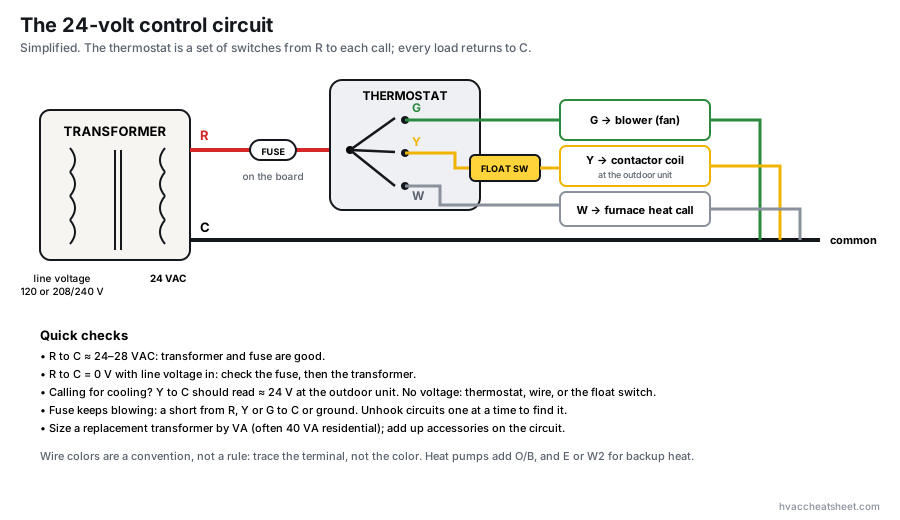
The fuse on the furnace control protects the transformer and board from a short in the 24 VAC circuit. A blown fuse means the furnace and the AC go dead, often with no LED code or a fuse-specific code.
What the codes look like
- Carrier 58CVA/58CVX: code 24, secondary voltage fuse is open.
- Rheem R96V: code 30, open fuse.
- Goodman GR9S80: EE5, open fuse.
- Trane S9X1/S9X2/S9B1: E12, open fuse (5 A).
Look up any code in the furnace error code lookup.
Where shorts usually are
- Outdoor unit wiring: the thermostat cable to the condenser rubbing on sheet metal or chewed by animals, or damaged by a weed trimmer.
- Contactor coil: a shorted coil in the outdoor unit.
- Thermostat wiring: a staple through the cable, or loose strands touching at the thermostat.
- Accessories: humidifiers, condensate pumps and float switches, zoning panels.
- Wiring mistakes: after a thermostat replacement, a wire landed on the wrong terminal.
How to find it
- Replace the fuse only with the same rating, and don't install a larger one.
- Disconnect the outdoor unit wires (Y and C) at the furnace. If the new fuse holds with a cooling call, the short is in the outdoor wiring or contactor.
- Remove the thermostat wires one at a time and test each conductor to ground with an ohmmeter (power off).
- Check the contactor coil's resistance; a near-zero reading means a shorted coil.
- Disconnect accessories one at a time.
The thermostat wiring diagrams show which wires go where.
Before you start
- Turn the power off at the furnace switch before pulling wires or measuring resistance. Ohmmeter readings on a live circuit are meaningless and can damage the meter.
- Note where every wire lands (a phone photo of the board works) before you disconnect anything.
- Have a few spare fuses. Finding a short often takes two or three fuses. Never jumper the fuse or install a bigger one to "see what happens": the transformer can burn up, and on some boards the traces will.
When it blows tells you where to look
| When the fuse blows | Most likely area |
|---|---|
| Immediately at power-up, no call | A short on R or C that's always energized: thermostat cable, a pinched wire in the furnace, a shorted accessory (humidifier, condensate pump, zone panel) |
| Only on a cooling call (Y) | The cable to the outdoor unit, the contactor coil, or a float switch wired in the Y circuit |
| Only on a heating call (W) | Wiring to the gas valve, a shorted gas valve coil, or the W conductor in the thermostat cable |
| Only with the fan on (G) | The G conductor, or an accessory wired to G |
| Randomly, hours or days apart | A wire that touches ground only when something moves: a cable rubbing on the condenser cabinet, vibration, wind, or a rodent-chewed spot |
Split the circuit: the fastest way to find it
Think of the 24 V system as branches. Remove branches until the fuse holds, then put them back one at a time.
- Disconnect everything that leaves the furnace: the thermostat wires and the outdoor unit wires at the board. Leave only the transformer and board.
- Install a new fuse and power up. If it blows now, the short is inside the furnace: a pinched harness, a shorted gas valve, a failed board or a bad transformer.
- Reconnect the thermostat cable only. If it blows, the short is in the thermostat cable or at the thermostat.
- Reconnect the outdoor unit and make a cooling call. If it blows now, the problem is outdoors.
- Add accessories back last, one at a time.
Reading the meter (power off)
- Each conductor to ground: with the wires disconnected at both ends, a good conductor reads OL (open) to the cabinet. A low reading means the insulation is broken somewhere.
- Conductor to conductor: R to C, Y to C and so on should read OL with nothing connected. A low reading means two conductors are touching.
- Contactor coil: usually tens of ohms. Near zero means a shorted coil.
- Gas valve coil: compare with the valve's spec; near zero means shorted.
Common mistakes
- Replacing the board first. The board is rarely the cause. A blown fuse is the board protecting itself.
- Missing a condensate float switch wired into the Y or R circuit. Some are wired incorrectly so they short instead of open.
- Only checking the thermostat end. Most outdoor cable shorts happen where the cable enters the condenser or rubs on a sharp edge near the disconnect.
- Not finding the cause after a thermostat swap. A stripped wire too long at the new thermostat, or C landed on R, is common.
After the repair
Run heating, cooling and fan-only calls with the panels on, and leave it running long enough for the condenser fan and contactor to cycle. Secure the outdoor cable with a bushing or grommet where it enters the cabinet so it can't rub through again.
FAQ
The fuse blows only when the AC runs. Why?
That points to the outdoor wiring or the contactor coil, which only see voltage during a cooling call.
Can I use a 5 amp fuse instead of 3 amp?
Only if the board specifies it. A bigger fuse can let a short damage the transformer or board.
Sources
One field tip a week
A short, practical HVAC tip in your inbox every week: diagnostics, charging, airflow and code changes. Free, unsubscribe anytime.
We'll only use your email for the newsletter. Privacy policy.
Related guides
Thermostat Blank or No Power: Finding the Missing 24 Volts
How to troubleshoot a blank thermostat: batteries, the C wire, the furnace door switch, a blown board fuse, a tripped float switch, the transformer and power to the air handler.
How to Test an HVAC Transformer: 24-Volt Checks, VA Rating and Shorts
How to test the 24-volt control transformer in a furnace or air handler, how to size a replacement by VA, and how to find the short that killed the last one.
Furnace Blowing Cold Air: A Diagnostic Order That Finds It Fast
Why a gas furnace blows cold or lukewarm air, in the order to check it: thermostat fan setting, lockouts, flame proving, limits, gas supply, and duct leaks.
Furnace Blinking Light Codes: How to Read Them on Any Brand
How furnace control boards report faults with LED flashes, how to read the code correctly, and what the common code categories point to.
Field reference for trained technicians. Always follow the equipment manufacturer's instructions, local code and safe work practices. See our editorial standards, or report a correction.