High Indoor Humidity with the AC Running: Causes and Fixes
An air conditioner removes moisture as a side effect of cooling. When the moisture side falls behind, customers say the house feels cold and clammy, or the AC never seems to catch up on muggy days.
The usual causes
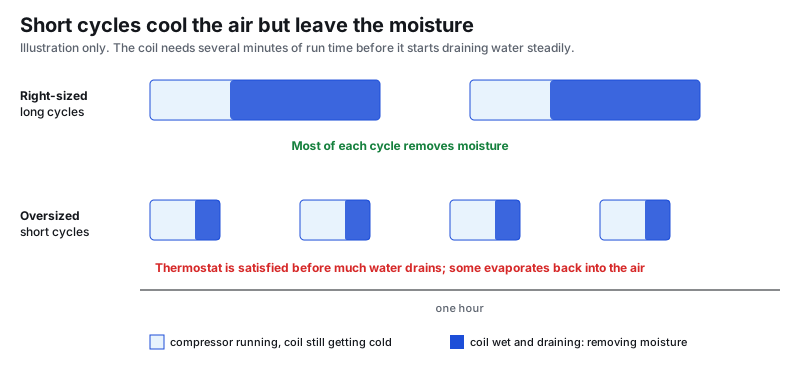
- Oversized equipment. Short cycles never let the coil drain much water. See oversized AC problems.
- Too much airflow. Airflow far above about 350–400 CFM per ton keeps the coil warmer, so it removes less moisture. See 400 CFM per ton.
- Fan set to "On." With the compressor off, the blower blows over a wet coil and puts moisture back into the house. Set the fan to "Auto" in humid climates.
- Return duct leaks. A leaky return in an attic or crawlspace pulls in hot, humid air. Check the return side, especially at the plenum and the platform.
- Too much outside air: an oversized fresh-air intake, exhaust fans running constantly, or a leaky house.
- Low load, mild weather: on 75 °F rainy days, the system barely runs, so it can't dehumidify. This is where a dehumidifier earns its place.
- Charge or coil problems: an undercharge or a dirty coil reduces capacity, and a coil that's iced then thawed dumps water back.
Measure first
- Indoor relative humidity and temperature in a couple of rooms.
- Supply air temperature and humidity: a coil doing its job brings supply air dew point well below the room's.
- Run times and cycles.
- Duct leakage, at least by inspecting the return side, or with a duct leakage test.
Fixes
- Lower cooling airflow within the manufacturer's range, or turn on a dehumidify setting.
- Fan to Auto.
- Seal the return and supply ducts, especially in unconditioned spaces.
- Balance ventilation, and use an ERV in humid climates where appropriate.
- Add a whole-house dehumidifier for homes with high latent loads.
- At replacement, choose variable-capacity equipment sized by load calculation.
What "normal" looks like
- Indoor relative humidity: most comfort guidance aims for roughly 40–60%, and many people feel best around 45–50% in summer. Above 60% for long periods invites mold, dust mites and that clammy feeling.
- Supply air: a system that's dehumidifying well usually puts out air in the low-to-mid 50s °F with a dew point well below the room's.
- Run time: long, steady cycles on hot days. If it runs 5–8 minutes and shuts off on a hot, humid day, suspect oversizing or a thermostat problem.
A simple field test
- Measure room temperature and RH with a calibrated meter.
- Measure supply air temperature and RH at a register close to the air handler.
- Calculate the dew point of each (most digital psychrometers do it for you).
- If the supply dew point isn't far below the room dew point after 15 minutes of running, the coil isn't removing much moisture. Check airflow, charge and coil cleanliness.
- Watch a full cycle. Note how long the compressor runs and whether the blower keeps running after it stops.
Comparing the fixes
| Fix | Best for | Watch out for |
|---|---|---|
| Fan to Auto | Every humid-climate home | Some people notice less air movement |
| Lower blower speed in cooling | Oversized systems, high airflow | Stay in the manufacturer's range; coil freezing if too low |
| Dehumidify mode on the thermostat or equipment | Variable-speed blowers | Needs compatible equipment and wiring |
| Seal return ducts | Homes with attic or crawl returns | Find leaks with a test, not guessing |
| Whole-house dehumidifier | Tight homes, mild humid weather, basements | Needs a drain and proper ducting |
| Right-size at replacement | Chronic problems with oversized equipment | Use a Manual J load calculation |
See Manual J vs. rule of thumb sizing for why sizing matters so much for humidity.
Common mistakes
- Lowering the thermostat to fight humidity. It makes the house colder but not much drier, and often leads to condensation on supply registers.
- Running the fan "On" for air circulation in summer. It re-evaporates water off the coil and drain pan.
- Ignoring the drain pan. A pan that holds water lets it re-evaporate. Make sure it drains freely.
- Adding a bigger system. Bigger equipment usually makes humidity worse, not better.
FAQ
What indoor humidity is normal?
Many guidelines suggest keeping indoor relative humidity roughly between 30% and 60%, with summer targets around 50% or a little under in humid climates.
Should the AC fan be on or auto?
In humid climates, Auto. Running the fan constantly can push moisture from the wet coil back into the house between cycles.
Can a new AC fix humidity?
Only if it's sized and set up correctly. An oversized new unit can make humidity worse. A load calculation and correct airflow matter more than the brand.
Sources
One field tip a week
A short, practical HVAC tip in your inbox every week: diagnostics, charging, airflow and code changes. Free, unsubscribe anytime.
We'll only use your email for the newsletter. Privacy policy.
Tools for this job
Related guides
400 CFM per Ton: Where the Rule Comes From and When It's Wrong
Why 400 CFM per ton is the default cooling airflow, when to set airflow lower or higher, and how to check what a system is actually moving.
Oversized AC: The Symptoms, Why It Happens and What to Do
How to recognize an oversized air conditioner, why it hurts humidity control and equipment life, and the options short of replacing it.
Belt-Drive Blowers: Belt Tension, Pulley Alignment, Bearings and Setting Airflow
How to service a belt-drive blower on older furnaces, air handlers and rooftop units, including belt tension and alignment, bearings, adjustable pulleys and how they change airflow.
MERV Ratings and Filter Pressure Drop: Picking a Filter That Won't Choke the System
What MERV ratings mean, how filter pressure drop affects airflow and static pressure, and how to choose a filter without restricting the blower.
Field reference for trained technicians. Always follow the equipment manufacturer's instructions, local code and safe work practices. See our editorial standards, or report a correction.