MERV Ratings and Filter Pressure Drop: Picking a Filter That Won't Choke the System
Customers ask for "the best filter," and a 1-inch MERV 13 jammed into an undersized slot can starve the blower. The real question is pressure drop.
What MERV means
MERV (Minimum Efficiency Reporting Value) comes from ASHRAE Standard 52.2 and rates how well a filter captures particles in three size ranges. In broad terms:
| MERV | Typical use |
|---|---|
| 1–4 | Basic fiberglass, protects the equipment only |
| 5–8 | Standard pleated, captures dust, pollen, mold spores |
| 9–12 | Better residential, captures finer dust and some smaller particles |
| 13–16 | High efficiency, captures much finer particles, including many bacteria-sized particles |
Pressure drop is what affects the system
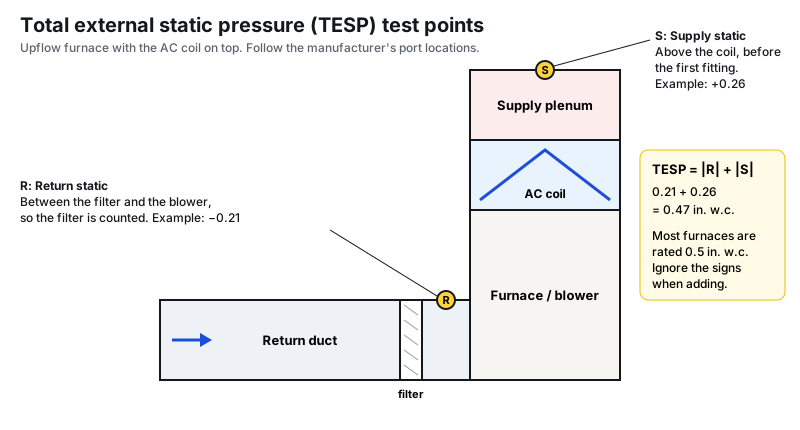
Every filter adds resistance. The blower can only overcome so much total external static pressure before airflow drops. A common budget for a 0.5 in. w.c. system allows about 0.10 in. w.c. for the filter. See total external static pressure.
What drives filter pressure drop:
- Face velocity: the same airflow through a smaller filter means higher velocity and higher pressure drop. Bigger face area = less restriction.
- Depth and pleat count: a 4–5" media filter has far more media area than a 1" filter of the same face size.
- Loading: pressure drop rises as the filter fills up.
- MERV: higher efficiency media generally restricts more, but only for the same area and depth.
How to choose
- Measure static pressure across the filter (before and after) with a manometer.
- If a 1" slot is already near its budget, don't go up in MERV. Add filter area instead: a larger grille, a second return or a deep media cabinet.
- Check the filter manufacturer's initial pressure drop data at your airflow and face size.
- Set a change interval based on measured pressure drop, not just the calendar.
Worked example: same airflow, different filters
A 3-ton system moving about 1,200 CFM through a single 16 × 25 return:
| Filter | Face area | Face velocity | What tends to happen |
|---|---|---|---|
| 1" MERV 8, 16 × 25 | about 2.8 sq ft | about 430 ft/min | Moderate pressure drop when clean; rises as it loads |
| 1" MERV 13, 16 × 25 | about 2.8 sq ft | about 430 ft/min | Higher pressure drop; can push total static over the rating |
| 4" MERV 13 media, 16 × 25 | about 2.8 sq ft face, much more media | about 430 ft/min at the face | Lower pressure drop than a 1" MERV 13 because the pleats add area |
| Two 1" MERV 8 returns, 20 × 25 each | about 6.9 sq ft | about 175 ft/min | Low pressure drop and slow air through the media |
Exact pressure drops come from the filter manufacturer's data at your airflow. The pattern is what matters: more area beats a less efficient filter.
How to measure filter pressure drop
- Drill test ports (or use existing ones) just before and just after the filter.
- With the blower running at its cooling speed, measure static pressure on each side with a manometer.
- The difference is the filter's pressure drop.
- Record it with the filter type and date on the static pressure test sheet. Re-measure at the next visit to set a real change interval.
Common mistakes
- Choosing a filter by MERV alone. Pressure drop at your airflow and size is what the blower feels.
- Ignoring filter fit. Gaps around a filter let air bypass it, so a high-MERV filter with bypass can clean worse than a well-sealed MERV 8.
- Using "allergy" filters in a small slot without checking static, then wondering why the coil freezes or the limit trips.
- Never re-measuring. A filter that starts at an acceptable drop can double it as it loads.
FAQ
Is MERV 13 bad for my furnace?
Not on its own. A MERV 13 in a properly sized media cabinet can run with low pressure drop. A MERV 13 crammed into an undersized 1" slot can restrict airflow. Measure the pressure drop.
What's the best MERV rating for a home?
Many homes do well with MERV 8–13, depending on air quality goals and how much filter area the system has. Higher efficiency needs more area to avoid restriction.
How often should filters be changed?
1" filters often need changing every 1–3 months. Deep media filters often last 6–12 months. Measuring pressure drop is the most reliable guide.
Sources
One field tip a week
A short, practical HVAC tip in your inbox every week: diagnostics, charging, airflow and code changes. Free, unsubscribe anytime.
We'll only use your email for the newsletter. Privacy policy.
Tools for this job
Related guides
Total External Static Pressure: How to Measure It and What's Normal
Measure total external static pressure with a manometer, compare it to the equipment's rating, and use it to find airflow restrictions.
Furnace High Limit Switch Tripping: Causes and How to Fix It
Why a furnace's high limit opens, how to confirm it with temperature rise and static pressure, and when the switch itself is the problem.
400 CFM per Ton: Where the Rule Comes From and When It's Wrong
Why 400 CFM per ton is the default cooling airflow, when to set airflow lower or higher, and how to check what a system is actually moving.
Belt-Drive Blowers: Belt Tension, Pulley Alignment, Bearings and Setting Airflow
How to service a belt-drive blower on older furnaces, air handlers and rooftop units, including belt tension and alignment, bearings, adjustable pulleys and how they change airflow.
Field reference for trained technicians. Always follow the equipment manufacturer's instructions, local code and safe work practices. See our editorial standards, or report a correction.