Reversing Valve Troubleshooting: Heat Pump Stuck in Heat or Cool
A reversing valve is a slide valve moved by refrigerant pressure. A small 4-way pilot valve, opened and closed by the solenoid coil, directs high and low pressure to the ends of the slide. When the valve doesn't shift, the cause is electrical (no signal or a dead coil), pressure (not enough difference to move the slide), or mechanical (a stuck slide or an internal leak).
1. Know which mode energizes the coil
Manufacturers pipe the valve so the coil is energized in either cooling or heating. If the coil fails, the valve goes to the other mode:
- Coil energized for cooling (O terminal; most brands): coil failure leaves the unit in heat.
- Coil energized for heating (B terminal; traditionally Rheem/Ruud): coil failure leaves the unit in cool.
Check the unit's wiring diagram and the thermostat setting. A thermostat set to O when the equipment needs B produces a heat pump that runs backward in both modes. See thermostat wiring.
2. Electrical checks
- Voltage at the coil: with the compressor running in the mode that should energize the coil, you should read 24 VAC at the coil leads (or the line voltage the coil is rated for on some commercial units). No voltage means a thermostat, wiring or defrost board problem, not the valve.
- Coil resistance: with the leads disconnected, an open (OL) or shorted reading means a bad coil. Coil replacement doesn't require opening the refrigerant circuit.
- Coil voltage rating: Ranco LDK coils come in 24, 120, 208/240 and 277 V versions; match the replacement. The valve is rated to shift at 85% to 110% of the coil's rated voltage.
- Don't energize a coil off the valve. Without the pilot stem in it, the coil draws excessive current and can burn out.
- Listen and feel. With the system running, switching modes (or cycling the coil on and off) should produce a distinct click and a whoosh as the slide moves.
3. Pressure: does it have enough to shift?
The slide needs a pressure difference to move. Ranco rates its valves to reverse at a minimum of 40 psi difference between high and low side (maximum 450 psi). A unit that's low on charge, has a weak compressor or was just started may not have enough. Let the system run and build head pressure, then try again.
4. Freeing a stuck slide
Contamination (braze scale, flux, debris from dirty line sets) is the usual cause of a sticking slide. Things that sometimes free it:
- Cycle the coil on and off several times while the compressor runs.
- Switch modes while the system has full pressure difference.
- Use a strong magnet on the valve body near the pilot to help it move (some techs do this; it doesn't always work).
- Lightly tap the valve body. Don't hit it hard; a dented body can stop the valve from reversing.
If it works once and sticks again, replace the valve. A stuck valve will come back.
5. Checking for an internal leak
An internally leaking valve lets hot discharge gas pass into the suction port. Symptoms are reduced capacity in both modes, lower than normal head pressure, higher than normal suction pressure, and a hot compressor.
Temperature check: with the unit running, measure the suction line where it enters the valve from the indoor or outdoor coil and where it leaves the valve toward the compressor. The suction line leaving the valve should be about the same temperature as the line coming in. A noticeably warmer line leaving the valve means hot gas is leaking across the slide.
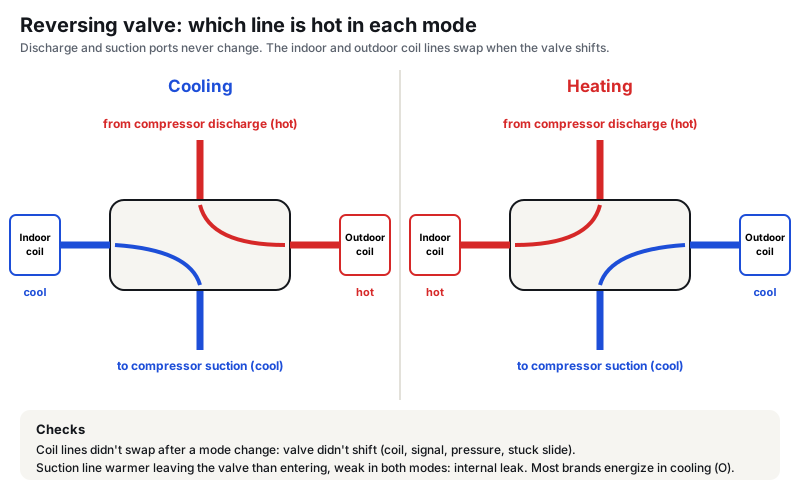
Expected port temperatures:
| Port | Cooling mode | Heating mode |
|---|---|---|
| Discharge (from compressor) | Hot | Hot |
| Suction (to compressor) | Cool | Cool |
| Indoor coil line | Cool | Hot |
| Outdoor coil line | Hot | Cool |
The indoor and outdoor coil lines should swap when the mode changes. If they don't, the valve hasn't shifted. Rule out a weak compressor before blaming the valve: a compressor that won't pump shows low head and high suction pressure too. See how to test a compressor.
6. Replacing the valve
- Recover the charge. Confirm which mode energizes the coil and match the piping.
- Keep the valve body at or below 250°F while brazing: wrap it in a wet rag or use heat paste, and point the flame away from the body. Ranco also calls for an inert gas purge to prevent oxide scale inside the tubing; see brazing with a nitrogen purge.
- Don't dent or flatten the body or capillary tubes.
- Replace the filter-drier, pull a deep vacuum (how to pull a deep vacuum), and charge to the manufacturer's specification.
- Note the likely cause on the invoice. If contamination caused it, tell the customer it can happen again.
FAQ
Is the reversing valve energized in heat or cool?
It depends on the brand. Most energize in cooling (O). Some energize in heating (B). Check the unit's wiring diagram.
What does a bad reversing valve solenoid sound like?
You won't hear the click and whoosh when the mode changes. Check 24 V at the coil and the coil's resistance before condemning the valve.
Can a reversing valve be stuck halfway?
Yes. A partly shifted valve leaks discharge gas to suction, giving poor capacity in both modes and a hot compressor.
Why does my heat pump blow cold air in heat mode?
It may be in defrost, the valve may not have shifted, or it may be low on charge. See heat pump blowing cold air.
Sources
One field tip a week
A short, practical HVAC tip in your inbox every week: diagnostics, charging, airflow and code changes. Free, unsubscribe anytime.
We'll only use your email for the newsletter. Privacy policy.
Related guides
Heat Pump Blowing Cold Air in Heat Mode: What's Normal and What's Not
Tell normal heat pump behavior (cool-feeling air, defrost) from real faults like reversing valve, O/B setup, low charge and aux heat problems.
Heat Pump Defrost: How It Works and How to Troubleshoot It
How heat pump defrost works on time-temperature and demand defrost boards, what's normal during defrost, and how to diagnose a heat pump that ices up or defrosts too often.
Heat Pump Auxiliary Heat vs. Emergency Heat: When Each Runs and Why Aux Runs Too Much
The difference between auxiliary heat and emergency heat on a heat pump, what's normal, and how to diagnose a heat pump that runs on aux heat constantly or never brings it on.
Furnace Gas Valve Not Opening: Igniter Glows but No Flame
How to tell whether a furnace that glows or sparks but never lights has a bad gas valve, a board that isn't sending 24 volts, a closed gas supply or a pressure problem, with the checks in order.
Field reference for trained technicians. Always follow the equipment manufacturer's instructions, local code and safe work practices. See our editorial standards, or report a correction.