How to Test a Compressor: Winding Resistance, Ground and Megohm Checks
Most compressors that "won't start" aren't bad. A weak capacitor, low voltage, a burned contactor or an open internal overload looks the same from the curb. Test in order and write every reading down before you condemn anything.
1. Confirm what's actually happening
- Voltage at the compressor, not just the disconnect. Measure across the contactor load side (T1 to T2) while the contactor is pulled in. Low voltage makes a compressor hum and trip.
- Is it humming, clicking off, or silent? A hum with high amps means it's trying to start (capacitor, locked rotor, low voltage). Silence with voltage present points at an open winding or the overload.
- Clamp the common wire during the start attempt. Locked-rotor amps (LRA on the data plate) for a few seconds, then the overload trips, means it's getting power but not turning.
2. Check the capacitor and contactor first
A failed run capacitor is the most common reason a PSC compressor won't start. Test it under load or with a µF meter: see how to test a run capacitor or the capacitor check calculator. Check the contactor for burned contacts and voltage drop: how to test a contactor.
3. Ohm the windings
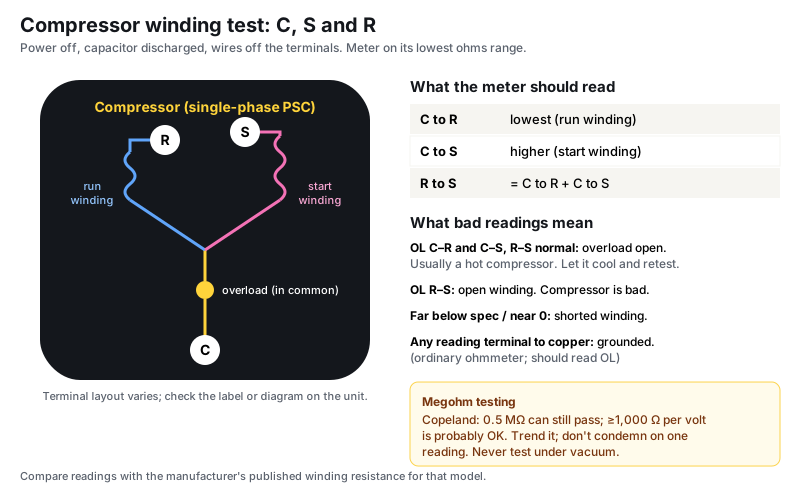
Turn off and lock out the power, discharge the capacitor, and pull the wires off the compressor terminals. Set your meter to its lowest ohms range.
| Reading | What it should look like |
|---|---|
| C to R (run winding) | The lowest of the three |
| C to S (start winding) | Higher than C to R |
| R to S | About equal to C to R + C to S |
Readings are low, usually a few ohms on the run winding of a residential compressor. Compare with the manufacturer's published resistance for that exact model; Copeland's mobile app and spec sheets list them.
What the readings tell you:
- All three add up and match spec: the windings are fine. Look elsewhere (capacitor, voltage, mechanical lock-up).
- OL from C to R and C to S, but a normal R to S reading: the internal overload in the common circuit is open. That usually means the compressor is hot. Let it cool fully (a hot shell can take a long time), then retest before condemning it. To find out why it overheated, see compressor tripping on internal overload.
- OL between R and S: an open winding. The compressor is bad.
- Much lower than spec, or near zero: shorted turns. The compressor is bad.
Three-phase scroll compressors read nearly equal resistance on all three legs; some models are deliberately unequal, so check the spec.
4. Check for a short to ground
With the wires still off, measure from each terminal to clean copper (the suction line or a scraped spot on the shell). On an ordinary ohmmeter you should see OL, no continuity. Any reading to ground means a grounded winding, and that compressor is done. A grounded compressor often trips the breaker the instant the contactor closes.
If the compressor terminals check clean but the breaker still trips, check the fan motor, crankcase heater and wiring. See AC breaker keeps tripping.
5. Megohm (insulation) testing, used carefully
A megohmmeter applies high DC voltage to measure insulation resistance. It's best used to track a compressor over time, not to condemn one on a single reading.
- Copeland's guidance is that values of at least 1,000 ohms per volt are probably acceptable, and that compressors reading as low as 0.5 megohm still pass the factory high-potential test.
- Liquid refrigerant in the oil, oil level, contamination and leakage through the terminal plate all lower the reading. A cold compressor with refrigerant in the oil can read low and be fine.
- Never megger or hi-pot a compressor while it's under vacuum. Copeland says this outright; test with pressure in the shell.
- Disconnect all wiring from the terminals first; contactors, wires and relays leak current and skew the reading.
6. If the windings are good but it won't turn
- Recheck voltage under load and the capacitor.
- Let pressures equalize. Some PSC compressors can't start against unequal pressures after a short off cycle. Scroll compressors normally start unloaded; see hard start kits.
- Locked rotor: a compressor that draws LRA with good voltage, a good capacitor and good windings is mechanically stuck. A properly matched start kit sometimes frees it, but a compressor that needs one every start is near the end.
- Scroll running backward (three-phase, loud, low amps, no pressure change): swap two legs at the contactor.
Before you replace it
Do an acid test on the oil if the compressor burned out. A burnout needs a suction-line filter-drier and a clean-up procedure, or the new compressor will follow the old one. Find out why it failed: high head pressure from a dirty condenser, low charge overheating the motor, low voltage, or liquid floodback.
FAQ
What should compressor windings read?
Run (C to R) is the lowest, start (C to S) is higher, and R to S is the sum of the two. The exact values depend on the model; get them from the manufacturer.
Why do I get OL from common to both run and start?
Usually the internal overload is open because the compressor is hot. You'll still read R to S. Let it cool and retest.
Can I condemn a compressor with a megger?
Not from one reading. Copeland says readings as low as 0.5 megohm can still be acceptable, and refrigerant in the oil lowers readings. Use it to track trends, and never test under vacuum.
Does a grounded compressor always trip the breaker?
Usually, often the moment the contactor closes. Confirm with the terminals disconnected so you don't blame the compressor for a grounded fan motor or wire.
Sources
One field tip a week
A short, practical HVAC tip in your inbox every week: diagnostics, charging, airflow and code changes. Free, unsubscribe anytime.
We'll only use your email for the newsletter. Privacy policy.
Tools for this job
Related guides
AC Compressor Not Starting: Humming, Clicking or Nothing at All
Diagnose a compressor that won't start by what it does: humming points to capacitor or locked rotor, clicking to overload, silence to the control circuit.
Hard Start Kits: When a Compressor Needs One and How to Pick It
What a hard start kit does, when a scroll or reciprocating compressor actually needs one, the difference between PTC and potential-relay kits, and how they wire in alongside the run capacitor.
How to Test a Run Capacitor: Meter Method and Under-Load Method
Test HVAC run capacitors two ways, with the meter's capacitance setting and under load with amps × 2652 ÷ volts, and know when to replace one.
AC Breaker Keeps Tripping: How to Find Out Why
How to diagnose an air conditioner or heat pump that keeps tripping its breaker: a grounded compressor, a locked rotor, a shorted fan motor, wiring faults, high head pressure or a weak breaker.
Field reference for trained technicians. Always follow the equipment manufacturer's instructions, local code and safe work practices. See our editorial standards, or report a correction.