Heat Pump Defrost: How It Works and How to Troubleshoot It
A light layer of frost on a heat pump's outdoor coil in heating mode is normal. A coil that turns into a block of ice is not.
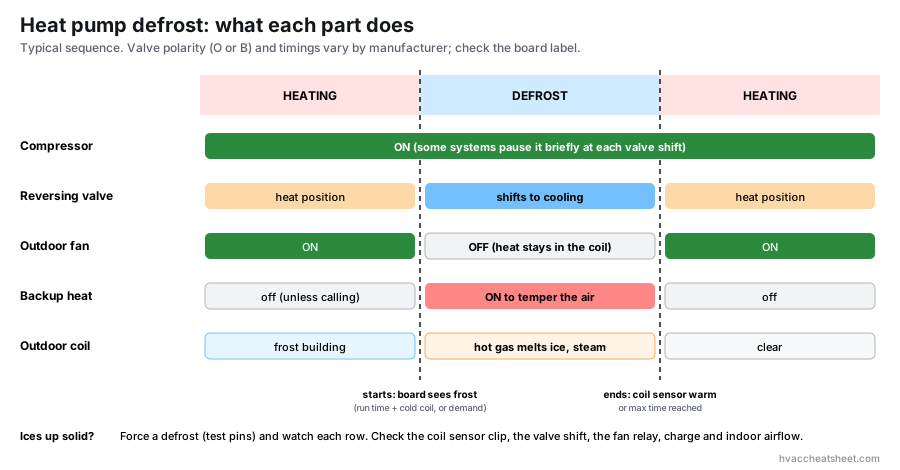
What happens during defrost
- The board decides it's time (see below).
- The reversing valve switches to cooling mode, sending hot gas to the outdoor coil.
- The outdoor fan stops, so the heat stays in the coil.
- Backup heat comes on (often through W2 or a defrost tempering output) so the house doesn't get blasted with cool air.
- Defrost ends when the coil sensor warms to its termination temperature or a maximum time runs out, whichever comes first.
- The valve switches back and the fan restarts. You'll see a cloud of steam and hear a "whoosh."
Steam, a paused outdoor fan and briefly cooler air from the vents are all normal during defrost.
Types of defrost control
| Type | How it starts defrost | Notes |
|---|---|---|
| Time-temperature | After a set amount of compressor run time (often a selectable 30, 60 or 90 minutes) while the coil sensor is below its set point | Simple; may defrost when it isn't needed |
| Demand defrost | When the coil temperature drops too far below outdoor air temperature, meaning frost is building | Uses outdoor and coil sensors; fewer unneeded cycles |
| Communicating/inverter | The control's own logic, using several sensors and pressures | Follow the manufacturer's service manual and codes |
Check the board's label or the service manual for its interval settings and termination temperature.
Troubleshooting a heat pump that ices up
- Check what the board is doing. Read any LED codes. Many boards have test pins that force a defrost; use them to check the rest of the sequence.
- Force a defrost and watch:
- Does the reversing valve switch? (Suction and discharge line temperatures should swap, and you'll hear it.)
- Does the outdoor fan stop?
- Does the coil clear and the sensor end defrost?
- Check the coil sensor: it must be clamped tight to the right tube (often near the bottom of the coil or a distributor tube) and insulated as the manufacturer shows. A loose sensor reads warm and never calls for defrost. Measure its resistance against the temperature chart in the service manual. See how to test a thermistor for the method.
- Check the outdoor sensor on demand defrost boards the same way.
- Check the reversing valve: coil voltage when it should be energized, and whether it actually shifts. A stuck valve can't defrost.
- Check the outdoor fan relay on the board: if the fan keeps running in defrost, the coil won't clear.
- Check the charge and indoor airflow. A low charge or low indoor airflow makes the outdoor coil run colder and frost faster. In heating, check charge the way the manufacturer specifies.
- Look at the unit's location: snow drifts, a roof dripping onto the unit, or a unit sitting in a low spot where meltwater refreezes can all cause ice buildup that defrost can't keep up with. Raise it on a stand if needed.
Defrosting too often or too long
| Symptom | Likely cause |
|---|---|
| Defrosts every cycle in mild, dry weather | Time interval set too short; failed coil sensor reading cold |
| Defrost runs to max time every time | Sensor not warming (loose or wrong location), low charge, outdoor fan not stopping |
| Never defrosts | Sensor reading warm, failed board, reversing valve stuck, no power to the valve |
| Ice only on the bottom of the coil | Meltwater refreezing: drainage, unit too low, or the base pan heater (if equipped) not working |
Common mistakes
- Calling normal defrost a problem. Explain the steam and the paused fan to the customer.
- Chipping ice off the coil. It damages fins and tubes. Use the forced defrost or warm water.
- Not checking the sensor clip. A loose sensor is one of the most common defrost failures.
- Checking charge in heat mode with cooling-mode targets. Use the manufacturer's heating charge method.
- Ignoring aux heat: if backup heat doesn't come on during defrost, customers complain about cold air. See heat pump blowing cold air.
Use the heat pump heating checklist to record the defrost test.
FAQ
How long should a heat pump defrost cycle last?
Usually a few minutes; many boards cap it at around 10 minutes or so. Check the manufacturer's maximum time.
How often should a heat pump go into defrost?
It depends on outdoor temperature and humidity. Wet weather around freezing causes the most frost. Time-temperature boards also depend on their interval setting.
Is it normal for a heat pump to steam?
Yes. Steam during defrost is the frost melting and evaporating off the warm coil.
Sources
One field tip a week
A short, practical HVAC tip in your inbox every week: diagnostics, charging, airflow and code changes. Free, unsubscribe anytime.
We'll only use your email for the newsletter. Privacy policy.
Related guides
Heat Pump Auxiliary Heat vs. Emergency Heat: When Each Runs and Why Aux Runs Too Much
The difference between auxiliary heat and emergency heat on a heat pump, what's normal, and how to diagnose a heat pump that runs on aux heat constantly or never brings it on.
Checking Heat Pump Charge in Heat Mode: What Works in Winter
Why superheat and subcooling targets from cooling don't apply in heat mode, what manufacturers recommend for winter charging, and how to tell if a heat pump is low on charge in heating.
Heat Pump Blowing Cold Air in Heat Mode: What's Normal and What's Not
Tell normal heat pump behavior (cool-feeling air, defrost) from real faults like reversing valve, O/B setup, low charge and aux heat problems.
Mini-Split Not Cooling or Heating: A Diagnostic Order for Ductless Systems
How to troubleshoot a ductless mini-split that runs but won't cool or heat: error codes, mode and remote settings, filters and blower wheels, the outdoor unit, sensors, communication and charge.
Field reference for trained technicians. Always follow the equipment manufacturer's instructions, local code and safe work practices. See our editorial standards, or report a correction.