Furnace Temperature Rise: How to Measure It and What the Reading Means
Temperature rise is the fastest way to check whether a furnace is moving the right amount of air for the heat it's making. It takes two thermometers and 15 minutes.
How to measure it
- Run the furnace at full fire (high stage on a two-stage furnace) for at least 10–15 minutes so temperatures settle.
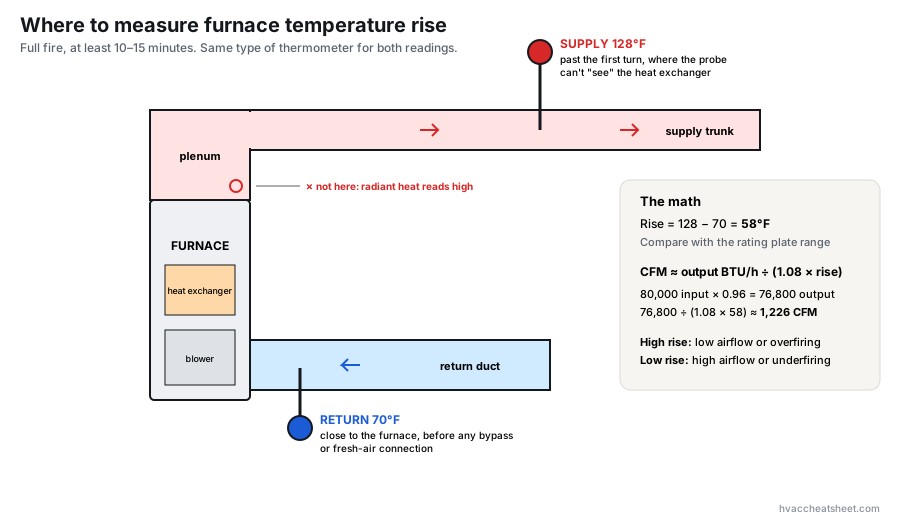
- Measure the return air in the return duct close to the furnace, before any humidifier bypass or fresh-air connection.
- Measure the supply air in the supply plenum or trunk, far enough from the heat exchanger that the probe can't "see" it. Radiant heat from the heat exchanger makes the supply read high. Just past the first elbow or a few feet down the trunk usually works.
- Subtract: supply − return = temperature rise.
- Compare with the rating plate range.
Use the same type of thermometer for both readings, and check that they agree when placed side by side.
Estimating airflow
Rearranging the sensible heat formula:
CFM ≈ output BTU/h ÷ (1.08 × temperature rise)
Output is the input from the rating plate times the efficiency. For a quick estimate, use the furnace's rated output (often listed on the plate) or input × its efficiency.
Example: an 80,000 BTU/h input, 96% furnace has about 76,800 BTU/h output. With a 50°F rise: 76,800 ÷ (1.08 × 50) ≈ 1,420 CFM.
The furnace airflow from temperature rise calculator does this math. The estimate depends on accurate input, so check the gas pressure or clock the meter when the number matters.
What a high rise means
| Cause | What to check |
|---|---|
| Dirty filter | Filter, and its pressure drop |
| High static pressure | Total external static pressure |
| Blower speed too low for heating | Heat speed tap or ECM setting |
| Dirty blower wheel or coil | Blower wheel, evaporator coil above the furnace |
| Closed or blocked registers, crushed ducts | Supply and return ductwork |
| Overfiring | Manifold pressure, orifice size, clocked input |
A high rise makes the high limit trip, shortens heat exchanger life and causes short cycling.
What a low rise means
| Cause | What to check |
|---|---|
| Blower speed too high for heating | Speed tap or ECM setting |
| Underfiring | Inlet and manifold gas pressure |
| Return air leak pulling in hot attic or furnace room air | Return duct sealing |
| Thermometer placement | Supply probe too far downstream, or in a bypass |
A low rise can make the air feel cool at the registers, and on 80% furnaces it can cause flue gas condensation in the heat exchanger and vent.
Two-stage and modulating furnaces
Check the rise at high fire against the rating plate range. Many two-stage furnaces also have a low-fire range; check it at low fire too. Variable-speed blowers adjust airflow by stage, so make sure the blower settings match the installed furnace size and the cooling tonnage.
Common mistakes
- Measuring too soon after startup, before temperatures settle.
- Putting the supply probe where it sees the heat exchanger, which reads high.
- Measuring at a register far from the furnace; duct losses make the rise look low.
- Using a range from a different furnace. Each model has its own.
- Fixing a high rise by turning down the gas instead of fixing airflow.
Record the rise on the furnace maintenance checklist.
FAQ
What is a normal furnace temperature rise?
Whatever range the rating plate lists for that furnace. Ranges like 30–60°F, 35–65°F and 40–70°F are common.
Why does my furnace blow warm but not hot air?
A low rise from high blower speed, low gas pressure or a return leak is common. Measure the rise and gas pressure before replacing parts.
Can temperature rise tell me the airflow for AC?
It gives you the heating airflow at the heating blower speed. Cooling usually runs at a different speed, so check cooling airflow separately.
Sources
One field tip a week
A short, practical HVAC tip in your inbox every week: diagnostics, charging, airflow and code changes. Free, unsubscribe anytime.
We'll only use your email for the newsletter. Privacy policy.
Tools for this job
Related guides
Furnace High Limit Switch Tripping: Causes and How to Fix It
Why a furnace's high limit opens, how to confirm it with temperature rise and static pressure, and when the switch itself is the problem.
Furnace Blowing Cold Air: A Diagnostic Order That Finds It Fast
Why a gas furnace blows cold or lukewarm air, in the order to check it: thermostat fan setting, lockouts, flame proving, limits, gas supply, and duct leaks.
Belt-Drive Blowers: Belt Tension, Pulley Alignment, Bearings and Setting Airflow
How to service a belt-drive blower on older furnaces, air handlers and rooftop units, including belt tension and alignment, bearings, adjustable pulleys and how they change airflow.
Furnace Flame Sensor: Microamp Readings, Cleaning and When to Replace
How flame rectification works, how to measure flame sensor microamps, what readings are normal, and how to fix weak flame signal.
Field reference for trained technicians. Always follow the equipment manufacturer's instructions, local code and safe work practices. See our editorial standards, or report a correction.