How to Check Furnace Gas Pressure: Inlet and Manifold with a Manometer
Gas pressure that's too low or too high causes weak heat, ignition problems, sooting, overheating and high CO. Checking it takes a manometer, a few fittings, and about 15 minutes.
Safety: You're opening the gas train. Turn the gas off before connecting or removing fittings, leak check every plug you remove and reinstall, and measure CO and draft after any adjustment. If you smell gas or can't stop a leak, shut the gas off and leave.
What you need
- A digital manometer (or a U-tube) that reads inches of water column (in. w.c.)
- The pressure tap fitting or adapter for the gas valve (some valves have a screw you back out; others need a hose barb in a 1/8" NPT tap)
- The furnace's rating plate and installation manual for the specified pressures
- Leak detection solution
Typical values
These are typical; the rating plate and manual are what count.
| Natural gas | Propane (LP) | |
|---|---|---|
| Inlet (supply) pressure | About 4.5–10.5 in. w.c. (7 in. common) | About 11–13 in. w.c. |
| Manifold, single-stage or high fire | 3.5 in. w.c. (often 3.2–3.8) | 10 in. w.c. (often 9.7–10.3) |
| Manifold, low fire (two-stage) | Varies widely by model (check the plate) | Varies widely by model (check the plate) |
Manufacturers commonly allow only small changes from the nominal manifold pressure (often ±0.3 in. w.c.). Bigger changes in input are made with different orifices, not the regulator.
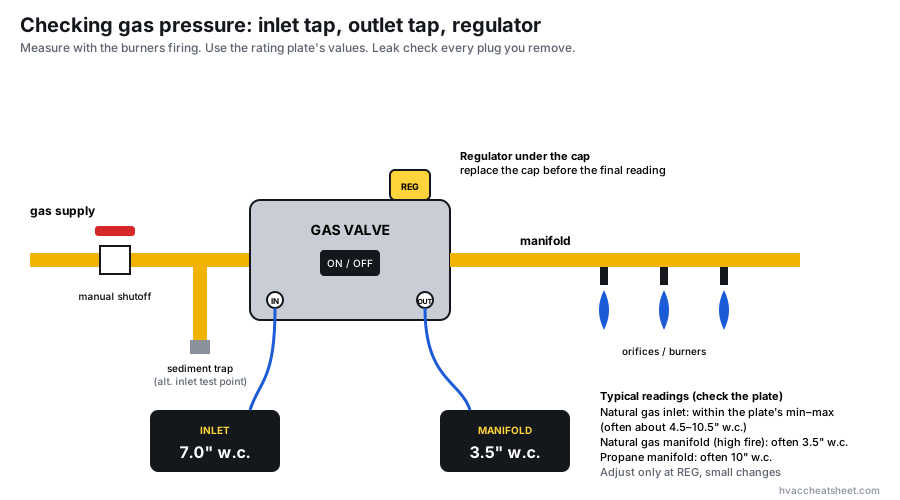
Measuring inlet pressure
- Turn off the gas at the furnace's manual shutoff.
- Connect the manometer to the gas valve's inlet pressure tap, or to a fitting at the drip leg.
- Turn the gas on and run the furnace. Also turn on the other gas appliances on the same line (water heater, range, dryer) to see the pressure under full load.
- Read the pressure with the burners firing. It must be inside the range on the rating plate.
- Turn the gas off, remove the manometer, reinstall the plug, and leak check it.
Low inlet pressure points to an undersized gas line, a long run, a failing meter or tank regulator, or too many appliances on one line. That's a supply problem, not something to fix at the furnace regulator. High inlet pressure can damage the gas valve; check the service regulator.
Measuring and setting manifold pressure
- Turn off the gas and power.
- Connect the manometer to the outlet (manifold) pressure tap on the gas valve.
- Restore gas and power and start the furnace. On two-stage furnaces, run it at the stage you're checking.
- Read the pressure with the burners firing.
- Adjust if needed: remove the regulator cap and turn the adjustment screw (usually clockwise to increase, counterclockwise to decrease; check the valve's markings). Make small changes and let it settle.
- Replace the regulator cap before the final reading; some valves read differently with it off.
- Shut down, remove the manometer, reinstall the plug and leak check.
Clocking the gas meter (natural gas)
Clocking checks the actual input against the rating plate:
- Turn off every other gas appliance.
- With the furnace at full fire, time how many seconds the meter takes to pass 1 cubic foot (use the smallest dial).
- Input (BTU/h) = heating value × 3,600 ÷ seconds per cubic foot. Get the heating value from the gas utility; it's often around 1,000–1,050 BTU per cubic foot.
Example: 1,030 BTU/ft³ and 45 seconds per cubic foot: 1,030 × 3,600 ÷ 45 = 82,400 BTU/h, close to an 80,000 BTU/h input furnace. Measured input must never be higher than the rating plate.
After any change
- Measure temperature rise and confirm it's within the range on the rating plate. Use the furnace airflow from temperature rise calculator.
- Run a combustion test and record CO and O₂ on the combustion analysis log.
- Watch the flame: steady, blue, centered in the heat exchanger openings, with no lifting or rollout.
What the readings point to
| Reading | Possible effect | Check |
|---|---|---|
| Manifold too low | Weak heat, low temperature rise, condensation in an 80% furnace, ignition trouble | Regulator setting, inlet pressure, staging wiring |
| Manifold too high | Overheating, high limit trips, rollout, sooting, high CO | Regulator setting, wrong orifices |
| Inlet drops a lot when other appliances start | Undersized gas piping or supply | Pipe sizing, meter or tank regulator |
| Correct pressure, poor flame | Dirty burners, wrong orifices, venting | Burners, orifice size for the fuel, vent and inducer |
Propane conversions
A furnace converted to propane needs the manufacturer's LP kit: a different regulator spring or valve setting and smaller orifices. Running propane through natural gas orifices badly overfires the furnace. After a conversion, mark the furnace with the conversion label, then check inlet and manifold pressure and run a combustion test.
Common mistakes
- Reading pressure without the burners firing. Static (lock-up) pressure is higher than operating pressure.
- Adjusting the regulator to fix a supply problem. If inlet pressure is low, the furnace regulator can't make it up.
- Big regulator changes to fix a wrong input. Change orifices instead.
- Forgetting the regulator cap before the final reading.
- Not leak checking the pressure tap plug afterward. It's the most common leak after a gas pressure check.
FAQ
What should manifold pressure be on a natural gas furnace?
Many furnaces call for 3.5 in. w.c. at high fire, but check the rating plate. Two-stage furnaces have a separate, lower low-fire setting.
Can low gas pressure cause a furnace to shut off?
Yes. Low pressure can cause weak flame signal, ignition lockouts and condensation problems. See furnace ignition lockout and flame sensor readings.
Do I need a digital manometer?
A U-tube works, but a digital manometer is faster, easier to read and doubles for static pressure and draft.
Sources
One field tip a week
A short, practical HVAC tip in your inbox every week: diagnostics, charging, airflow and code changes. Free, unsubscribe anytime.
We'll only use your email for the newsletter. Privacy policy.
Tools for this job
Related guides
Furnace Blowing Cold Air: A Diagnostic Order That Finds It Fast
Why a gas furnace blows cold or lukewarm air, in the order to check it: thermostat fan setting, lockouts, flame proving, limits, gas supply, and duct leaks.
Furnace Ignition Lockout: Failed Ignition Troubleshooting Step by Step
Diagnose a furnace that tries to light and locks out by following the ignition sequence: inducer, pressure switch, igniter, gas valve, flame sense.
Furnace Temperature Rise: How to Measure It and What the Reading Means
How to measure furnace temperature rise correctly, where the normal range comes from, how to estimate airflow from it, and what a high or low rise tells you.
Standing Pilot Won't Stay Lit: Thermocouple Testing on Older Furnaces and Boilers
How a standing pilot and thermocouple work on older furnaces, boilers and water heaters, how to test the thermocouple with open-circuit and closed-circuit millivolt readings, and what else makes a pilot go out.
Field reference for trained technicians. Always follow the equipment manufacturer's instructions, local code and safe work practices. See our editorial standards, or report a correction.