Furnace High Limit Switch Tripping: Causes and How to Fix It
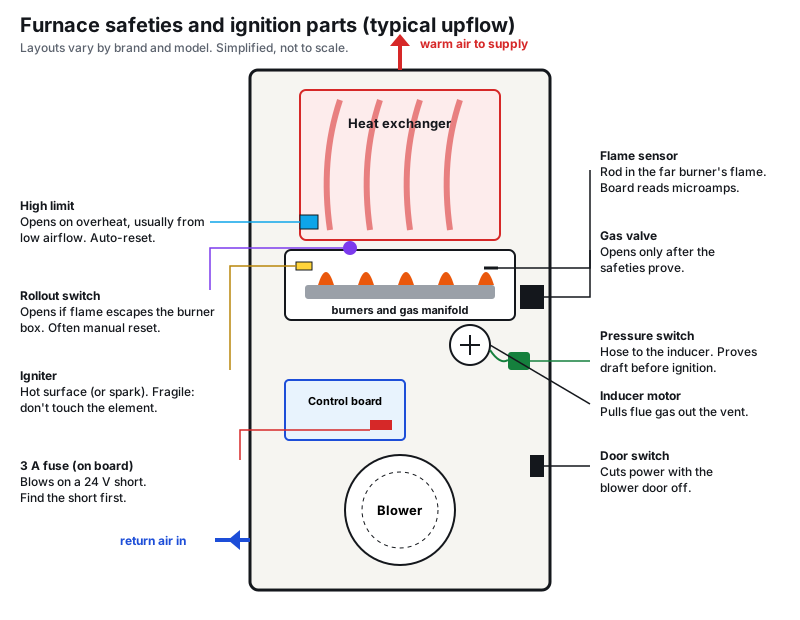
The high limit (also called the main or primary limit) is a safety switch that opens when air at the heat exchanger gets too hot. When it opens, the control shuts the gas off and runs the blower to cool things down. Repeated trips show up as limit codes and eventually a lockout.
Safety: Never jumper a limit switch to keep a furnace running. An overheating heat exchanger can crack and leak carbon monoxide.
What the codes look like
- Lennox ML180UH: 4 flashes, primary limit switch open.
- Carrier 58CVA/58CVX: code 33 (limit circuit fault) and code 13 (limit circuit lockout).
- Rheem R96V: code 22, main limit open.
- Goodman GR9S80: EE3, open high limit switch.
- Trane S9X1/S9X2/S9B1: E04, open limit (main limit, rollout or reverse airflow switch).
Look up any code in the furnace error code lookup for the full tables.
Step 1: The easy airflow checks
Most limit trips come from something blocking air:
- Dirty or wrong filter (a high-MERV filter that's too restrictive for the duct system)
- Closed or blocked supply registers and returns
- Dirty blower wheel
- Dirty evaporator coil above the furnace
- Collapsed or disconnected flex duct
- Blower on the wrong speed tap or a failing blower motor or capacitor
Step 2: Measure temperature rise
Measure the supply and return air temperatures once the furnace has run 10 to 15 minutes, out of line of sight of the heat exchanger. The difference is the temperature rise. Compare it with the range on the furnace rating plate (often something like 35–65°F or 40–70°F).
- Rise too high: not enough airflow, or the furnace is overfiring.
- Rise in range: airflow is probably fine; look harder at the switch and wiring.
The temperature rise calculator estimates airflow from the rise and the furnace's output.
Step 3: Measure static pressure
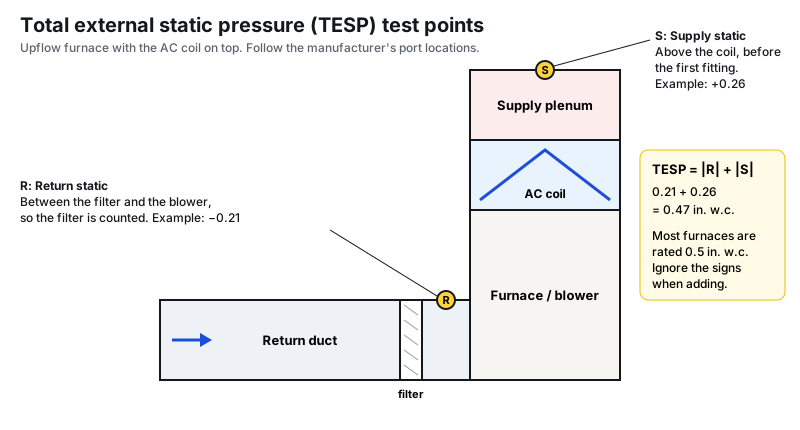
Measure total external static pressure and compare it with the furnace's blower table. High static means the duct system, filter or coil is restricting airflow. Fixing that is the real repair.
Step 4: Check for overfiring
Clock the gas meter or measure manifold pressure and compare with the rating plate and installation manual. Wrong orifices (for example after an LP conversion), high manifold pressure or the wrong furnace size for the ducts can all overheat the heat exchanger.
Step 5: Then test the switch
With power off, check the limit for continuity at room temperature. A limit that opens far below its rated temperature, or reads open when cold, is bad. Replace it only with the exact part for that furnace model; the rating and location matter.
What normal looks like
| Measurement | Typical target |
|---|---|
| Temperature rise | Within the range on the rating plate (often something like 30–60°F or 35–65°F) |
| Total external static pressure | At or below the rating, commonly 0.5 in. w.c. |
| Filter pressure drop | A small share of the total; a clean 1" filter often around 0.1 in. w.c. |
| Manifold gas pressure | Set to the rating plate (high fire and low fire on two-stage) |
A furnace operating above its temperature rise range is overheating its heat exchanger every cycle, even if the limit hasn't tripped yet.
Common mistakes
- Replacing the limit switch first. Limit switches rarely fail closed or open on their own. When one trips, the furnace is usually telling the truth about airflow.
- Ignoring the return side. Undersized or crushed returns, a closed return grille or a blocked filter rack are as common as supply problems.
- Using a high-MERV 1" filter on a system with marginal returns. It can push static pressure over the rating. See MERV ratings and filter pressure drop.
- Speeding up the blower without checking static. More speed on a restricted system adds noise and may not add much airflow.
- Not checking the coil. A dirty evaporator coil above the furnace restricts airflow in heating too.
When the limit keeps tripping after you fix airflow
- Overfiring: clock the gas meter or measure manifold pressure. Wrong orifices (for example, natural gas orifices on LP) cause overfire.
- Blower problems: a failing ECM module or a weak PSC motor or capacitor can lower airflow only after warming up.
- Wrong limit for the model: replacement limits must match the original's temperature rating and type exactly.
- Heat exchanger restriction: soot or rust blocking cells can create hot spots near the limit.
FAQ
Why does the limit trip only on the hottest heating days or after a few cycles?
Long run times push the heat exchanger to its highest temperature, so a marginal airflow problem shows up then. Measure rise and static during a long run.
Can a dirty filter really cause a limit trip?
Yes. It's the most common cause. Replace the filter and recheck before going further.
Is a limit trip dangerous?
The switch tripping is the safety doing its job. Repeated overheating can damage the heat exchanger over time, so find the cause.
Sources
One field tip a week
A short, practical HVAC tip in your inbox every week: diagnostics, charging, airflow and code changes. Free, unsubscribe anytime.
We'll only use your email for the newsletter. Privacy policy.
Tools for this job
Related guides
Furnace Temperature Rise: How to Measure It and What the Reading Means
How to measure furnace temperature rise correctly, where the normal range comes from, how to estimate airflow from it, and what a high or low rise tells you.
Furnace Short Cycling: 7 Causes and How to Pin Down Which One
Diagnose a gas furnace that lights and shuts off too soon, from flame sensing and limit trips to oversizing and thermostat settings.
Furnace Blowing Cold Air: A Diagnostic Order That Finds It Fast
Why a gas furnace blows cold or lukewarm air, in the order to check it: thermostat fan setting, lockouts, flame proving, limits, gas supply, and duct leaks.
Furnace Pressure Switch Troubleshooting: Open, Stuck Closed and Dropping Out
Diagnose furnace pressure switch codes by measuring the inducer's draft with a manometer and checking vent, intake, hose, condensate trap and switch.
Field reference for trained technicians. Always follow the equipment manufacturer's instructions, local code and safe work practices. See our editorial standards, or report a correction.