Furnace Blinking Light Codes: How to Read Them on Any Brand
The furnace control board usually tells you what failed. The challenge is reading it correctly, because codes aren't standard across brands. Look up a specific code in the furnace error code lookup.
How to read the code
- Look before you open anything. Many furnaces have a small sight glass in the blower door so you can see the LED without breaking the door switch. Opening the door cuts power on most units and can clear the code.
- Count the pattern. Common formats:
- Flash count: 3 flashes, a pause, repeat = code 3.
- Two-digit flash: short flashes for the first digit, a pause, then flashes for the second (like 3 then 1 = code 31).
- Seven-segment display: letters and numbers on a small display (like E-codes on many Lennox boards).
- Steady on, rapid flash, slow flash: often normal-operation or flame status indicators, not faults.
- Find the right chart. Use the label inside the furnace door or the service manual for that exact model. The same flash count can mean different things on different brands.
- Check fault history. Many boards store the last several faults. Some show them when you press a button or briefly short the TEST pins. Follow the manual.
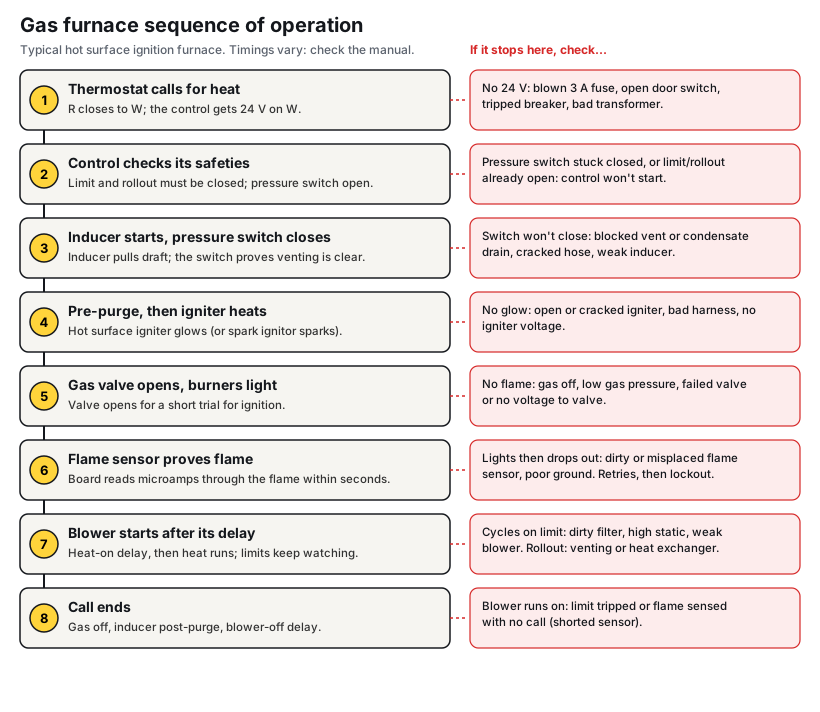
What the common code categories point to
| Code category | What it usually means | Where to look |
|---|---|---|
| Pressure switch open / failed to close | Inducer isn't proving draft | Vent, intake, condensate trap, hose, inducer. See pressure switch troubleshooting |
| Pressure switch closed / stuck | Switch closed before the inducer starts | Stuck switch, wiring |
| Limit open | Overheating | Low airflow: filter, blower, coil, ducts. See short cycling |
| Flame rollout | Flame left the burner area | Blocked heat exchanger or flue, possible cracked exchanger. Check CO |
| Ignition lockout / failure to ignite | No flame proven after retries | Igniter, gas supply, gas valve, flame sensor |
| Flame sensed with gas valve off | Board sees flame when it shouldn't | Leaking gas valve or a board fault. Serious |
| Low flame signal | Weak flame rectification | Flame sensor, ground, polarity |
| Reversed polarity / no ground | Line-voltage wiring issue | Hot/neutral swapped, missing ground |
| Blower or ECM fault | Blower motor or communication problem | Motor, module, wiring |
Good habits
- Write the code down and take a photo before you reset anything.
- Fix the cause, not just the code. A furnace that's reset over and over without a repair will come back to the same fault, and some faults (like rollout) are safety issues.
- Lockouts reset on their own on many boards after about an hour. That's not a fix either.
Worked example: from code to repair
A Carrier 58CVA shows code 33 on the LED:
- Look it up: on that board, 33 is a limit circuit fault (high limit or rollout opened). See the Carrier 58CVA code table.
- Check which switch opened. A tripped manual-reset rollout switch is a different problem from an auto-reset limit opening on airflow.
- For a limit trip, check the filter, blower and coil, then measure temperature rise and static pressure. See furnace high limit tripping.
- For a rollout trip, inspect the vent and heat exchanger and measure CO. See furnace rollout switch tripped.
- Fix the cause, then run several full cycles and confirm no new codes.
Normal status indicators
Not every light is a fault. Common normal patterns:
| Pattern | Often means |
|---|---|
| Steady on | Power on, no call, normal |
| Slow, steady blink | Normal operation, sometimes "heartbeat" |
| Rapid flashing during a call | Flame sensed, or a normal sequence stage on some boards |
| Off | No power, blown fuse, door switch open, or a failed board |
Check the label for that board before treating a light as a fault.
Common mistakes
- Opening the door before reading the LED. On many furnaces that cuts power and clears the code.
- Using a code from a different brand's chart. Code 33 on one board can mean something completely different on another.
- Ignoring the fault history. Intermittent problems often show up only in stored codes.
- Resetting a rollout code without inspecting. It's a safety trip.
- Replacing the board because it "shows a code." The board is reporting the problem; it's rarely the problem.
Record the code and what you found on the service call diagnostic sheet.
FAQ
Why does my furnace light blink even when it's working?
Many boards blink a slow, steady pattern or show a status code during normal operation. Check the chart: a "normal" heartbeat isn't a fault.
Does turning the power off clear furnace codes?
On many boards, yes, which is why you should read the LED through the sight glass first. Some boards keep a fault history you can recall later.
Where is the furnace code chart?
Usually on a label inside the blower door or burner door, and in the installation and service manuals.
Sources
One field tip a week
A short, practical HVAC tip in your inbox every week: diagnostics, charging, airflow and code changes. Free, unsubscribe anytime.
We'll only use your email for the newsletter. Privacy policy.
Tools for this job
Related guides
Furnace Blowing Cold Air: A Diagnostic Order That Finds It Fast
Why a gas furnace blows cold or lukewarm air, in the order to check it: thermostat fan setting, lockouts, flame proving, limits, gas supply, and duct leaks.
Furnace Inducer Motor: Testing, Noises and When It's Really the Pressure Switch
How a furnace draft inducer works, how to test one that won't start, runs noisy or runs but won't prove, and how to tell an inducer problem from a pressure switch or venting problem.
Furnace Flame Sensor: Microamp Readings, Cleaning and When to Replace
How flame rectification works, how to measure flame sensor microamps, what readings are normal, and how to fix weak flame signal.
Furnace Short Cycling: 7 Causes and How to Pin Down Which One
Diagnose a gas furnace that lights and shuts off too soon, from flame sensing and limit trips to oversizing and thermostat settings.
Field reference for trained technicians. Always follow the equipment manufacturer's instructions, local code and safe work practices. See our editorial standards, or report a correction.