Furnace Flame Rollout Switch Tripped: What It Means and What to Check
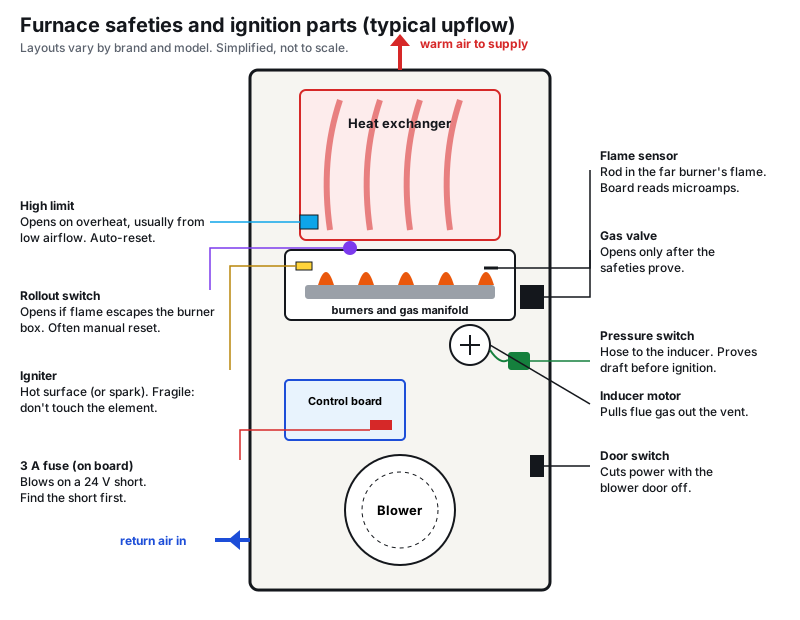
The rollout switch sits near the burners. If the flame "rolls out" of the burner box, heat hits the switch and it opens, shutting off the gas. Most are manual-reset (a small button), so the furnace stays off until someone resets it.
Safety: A rollout trip points to a combustion or venting problem that can produce carbon monoxide or a fire. Don't reset it repeatedly, and never bypass it. Check CO and draft before returning the furnace to service.
What the codes look like
- Lennox ML180UH: 5 flashes, rollout switch open.
- Carrier 58CVA/58CVX: the rollout is in the limit circuit, so it shows as code 33 or code 13.
- Rheem R96V: code 33, over-temperature switch (roll-out) open.
- Goodman GR9S80: E11, open rollout switch.
- Trane S9X1/S9X2/S9B1: E04, open limit (includes the rollout switch).
Look up any code in the furnace error code lookup.
Common causes
- Blocked flue or vent. Debris, a bird nest, a disconnected vent or a blocked chimney liner.
- Restricted heat exchanger. Soot or debris blocking the heat exchanger cells.
- Inducer problems. A weak or failing inducer that can't pull combustion gases through.
- Overfiring. High manifold pressure or wrong orifices.
- Burner problems. Misaligned, rusted or dirty burners, or delayed ignition causing a puff of flame.
- Cracked heat exchanger. Air from the blower pushing through a crack can disturb the flame.
How to check it
- Look at the flame with the burner door off (where the manufacturer allows) and watch through ignition and when the blower starts. The flame should be steady and stay in the burner. If it moves, lifts or rolls when the blower starts, suspect the heat exchanger.
- Inspect the vent from the furnace to the termination.
- Check the draft and the inducer's pressure at the pressure switch.
- Measure manifold gas pressure and compare with the rating plate.
- Inspect the burners and heat exchanger with a light and camera.
- Measure CO in the flue and in the living space.
Replace the rollout switch only if it's open when cold and nothing above explains the trip. Use the exact replacement part.
Why you shouldn't just reset it
A rollout switch is a last-line safety. When it trips, flame or very hot gases left the burner area, often because combustion products can't get out the vent the normal way. That can mean carbon monoxide entering the home, or fire risk near wiring. Resetting it without finding the cause puts the furnace back in the same condition.
If you find a tripped rollout switch:
- Leave the furnace off if you can't find the cause on the spot.
- Check CO in the living space and at the furnace. Make sure working CO alarms are in the home.
- Inspect before restarting, then reset and watch the full cycle from ignition through blower start.
What the evidence looks like
| What you see | What it usually means |
|---|---|
| Soot or scorching above the burner box | Flame has been rolling out for a while: blockage or overfire |
| Flame that lifts, wavers or reaches out when the blower starts | Possible cracked heat exchanger letting blower air into the combustion side |
| Rust flakes or debris on the burners | Restriction in the heat exchanger or vent; rust from condensation |
| Lazy, yellow, floating flames | Not enough combustion air or a draft problem |
| A puff or "whoomp" at ignition | Delayed ignition from dirty or misaligned burners or carryover |
| Melted wire insulation near the burners | Long-term rollout; check and replace damaged wiring |
Testing the switch itself
With power off, measure across the switch. A closed switch reads near zero ohms. If it's open, press the reset (if it has one). A switch that won't reset when cool, or reads open after resetting, has failed. A switch that resets and holds is not the problem; something made it trip.
Common mistakes
- Replacing the switch with a different temperature rating. Use the exact part number. A higher rating can let a real problem continue.
- Jumpering the switch to "test." Never run a furnace with a safety bypassed.
- Not checking the vent termination. Bird nests, snow, ice and crushed pipe are common causes, especially after the furnace sat all summer.
- Missing the heat exchanger. A visual check with a camera and a CO test at the flue and supply tell you more than a glance.
After the repair
Run several full cycles with the burner door on. Measure flue CO and draft, check manifold pressure against the rating plate, and confirm no flame disturbance when the blower starts. Record your readings on a combustion analysis log.
FAQ
Can I just press the reset button?
Once, while you watch the flame and look for the cause. If it trips again, the furnace needs a full combustion and vent inspection before running.
Is a rollout switch the same as a high limit?
No. The high limit protects against overheating from low airflow. The rollout switch catches flame escaping the burner area. Some controls report both through the same limit circuit code.
Sources
One field tip a week
A short, practical HVAC tip in your inbox every week: diagnostics, charging, airflow and code changes. Free, unsubscribe anytime.
We'll only use your email for the newsletter. Privacy policy.
Related guides
Furnace Blowing Cold Air: A Diagnostic Order That Finds It Fast
Why a gas furnace blows cold or lukewarm air, in the order to check it: thermostat fan setting, lockouts, flame proving, limits, gas supply, and duct leaks.
Furnace Pressure Switch Troubleshooting: Open, Stuck Closed and Dropping Out
Diagnose furnace pressure switch codes by measuring the inducer's draft with a manometer and checking vent, intake, hose, condensate trap and switch.
Furnace Blinking Light Codes: How to Read Them on Any Brand
How furnace control boards report faults with LED flashes, how to read the code correctly, and what the common code categories point to.
Furnace High Limit Switch Tripping: Causes and How to Fix It
Why a furnace's high limit opens, how to confirm it with temperature rise and static pressure, and when the switch itself is the problem.
Field reference for trained technicians. Always follow the equipment manufacturer's instructions, local code and safe work practices. See our editorial standards, or report a correction.