Standing Pilot Won't Stay Lit: Thermocouple Testing on Older Furnaces and Boilers
Standing pilots are mostly gone from new furnaces, but techs still see them every winter on older furnaces, wall heaters, floor furnaces, boilers and water heaters. The fix is usually simple once you know the readings.
Safety: If you smell gas, stop and ventilate before relighting anything. After repairs, check for gas leaks at every fitting you touched, and check draft and CO. Never hold the pilot button down with a wire or clamp to "test" a system.
How it works
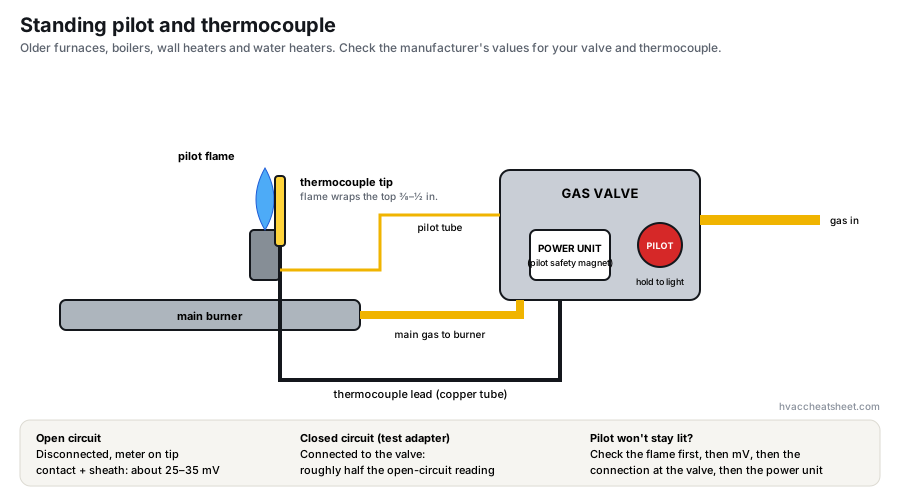
- The pilot flame heats the tip of the thermocouple.
- The heat produces a small DC voltage, measured in millivolts (mV).
- That voltage powers an electromagnet (the power unit or pilot safety) inside the gas valve, which holds the pilot gas open.
- If the pilot goes out, the voltage drops off, the magnet releases, and the gas valve shuts off all gas.
That's why the pilot stays lit while you hold the button (you're holding the valve open by hand) but goes out when you release it if the thermocouple circuit is weak.
Readings
| Test | How it's taken | Typical good reading |
|---|---|---|
| Open circuit | Thermocouple disconnected from the valve, meter on the tip contact and the outer sheath, pilot held lit | About 25–35 mV |
| Closed circuit | Thermocouple connected to the valve through a test adapter, pilot lit | Roughly half of the open circuit reading (often around 12–15 mV) |
| Closed circuit with burner on | Same as above, main burner firing | About the same as closed circuit |
| Dropout | Pilot blown out, watching the reading fall until the valve clicks closed | Very low; the valve should drop out within the manufacturer's time |
Check the manufacturer's numbers for the valve and thermocouple you're working on. Thermocouple makers list the expected output, often around 30 mV open circuit.
Step by step
- Look at the pilot flame. It should be steady, mostly blue, and wrap the top 3/8 to 1/2 inch of the thermocouple tip. A small, yellow, lazy or lifting flame won't heat it enough.
- Clean the pilot if the flame is weak: a dirty pilot orifice or a spider web in the pilot tube is common. Clean it as the manufacturer directs; don't enlarge the orifice.
- Check the thermocouple position: it must sit in the flame. Bent brackets and loose clips are common.
- Test open circuit millivolts. Low readings with a good flame mean a worn thermocouple.
- Test closed circuit with an adapter if you have one. A good open-circuit reading but a very low closed-circuit reading can point to a bad connection or a power unit problem.
- Check the connection at the valve: snug it a quarter turn past finger tight. Too loose loses millivolts; too tight can damage the power unit.
- Replace the thermocouple if it reads low. Match the length and connection; universal kits include adapters.
- If a new thermocouple reads well but the pilot still won't hold, the gas valve's power unit or the valve itself may be the problem.
Other reasons a pilot goes out
- Drafts: a door, return grille or vent pulling air across the pilot.
- Flue problems: a blocked flue or poor draft can starve the pilot of air or let flue gas affect the flame. Check draft.
- Dirty or sooted thermocouple tip.
- Low gas pressure. See how to check furnace gas pressure.
- Flame rollout or spill switches wired into the thermocouple circuit on some appliances. A tripped safety in that circuit drops the pilot.
- A thermopile system (some wall heaters and fireplaces use a thermopile with several hundred millivolts instead of a thermocouple). Test it to its own spec.
Thermocouple vs. thermopile
| Thermocouple | Thermopile | |
|---|---|---|
| Output | About 30 mV | Several hundred mV (often rated around 750 mV) |
| Job | Holds the pilot safety open | Powers the gas valve and the thermostat circuit (millivolt systems) |
| Where | Older furnaces, boilers, water heaters | Wall heaters, floor furnaces, fireplaces, some boilers |
Common mistakes
- Replacing the thermocouple without checking the pilot flame. A weak flame makes a new thermocouple fail the same way.
- Overtightening the thermocouple nut at the valve.
- Bending the new thermocouple into a kink or leaving it out of the flame.
- Ignoring draft. A pilot that goes out on windy days or when the dryer runs points to a venting or combustion air problem.
- Testing with a meter that can't read millivolts accurately.
FAQ
How long does a thermocouple last?
Often many years, but heat, soot and a poor pilot flame shorten their life. If the old one lasted only a short time, look at the flame and draft.
Why does my pilot light go out when the burner comes on?
A pressure drop or a draft change when the main burner fires can push the pilot flame off the thermocouple. Check gas pressure, the pilot flame and draft with the burner running.
Can I replace a standing pilot with electronic ignition?
On many older furnaces, replacing the furnace makes more sense. Conversion kits exist for some appliances; follow the manufacturer and local code.
Sources
One field tip a week
A short, practical HVAC tip in your inbox every week: diagnostics, charging, airflow and code changes. Free, unsubscribe anytime.
We'll only use your email for the newsletter. Privacy policy.
Related guides
Millivolt Wall Heaters and Floor Furnaces: Thermopile and Gas Valve Troubleshooting
How millivolt (powerpile) systems on wall heaters, floor furnaces and fireplaces work, how to test the thermopile, and how to find the voltage drop that keeps the main burner from lighting.
How to Check Furnace Gas Pressure: Inlet and Manifold with a Manometer
Step by step for measuring furnace inlet and manifold gas pressure with a manometer, typical ranges for natural gas and propane, how to adjust, and how to clock the meter.
Furnace Ignition Lockout: Failed Ignition Troubleshooting Step by Step
Diagnose a furnace that tries to light and locks out by following the ignition sequence: inducer, pressure switch, igniter, gas valve, flame sense.
How to Test a Furnace Hot Surface Igniter (and Why They Keep Failing)
How to test a hot surface igniter by watching the sequence, checking voltage and measuring resistance, the difference between silicon carbide and silicon nitride igniters, and what shortens their life.
Field reference for trained technicians. Always follow the equipment manufacturer's instructions, local code and safe work practices. See our editorial standards, or report a correction.