Furnace Ignition Lockout: Failed Ignition Troubleshooting Step by Step
Most furnaces try to light three or four times, then lock out. The fastest diagnosis is to watch one full sequence and note exactly where it fails.
Safety: Gas and 120-volt work is for trained technicians. If you smell gas, stop and leave the area.
What the codes look like
- Lennox ML180UH: 7 flashes (burners fail to light) or 8 flashes (lost flame too many times).
- Carrier 58CVA/58CVX: code 14, ignition lockout; code 34, ignition-proving failure.
- Rheem R96V: code 11 (failed ignition), 13 (flame lost after established), 10 (one-hour lockout).
- Goodman GR9S80: EE0, lockout due to excessive retries.
- Trane S9X1/S9X2/S9B1: E2.1 (retries exceeded) or E2.2 (recycles exceeded).
Look up any code in the furnace error code lookup.
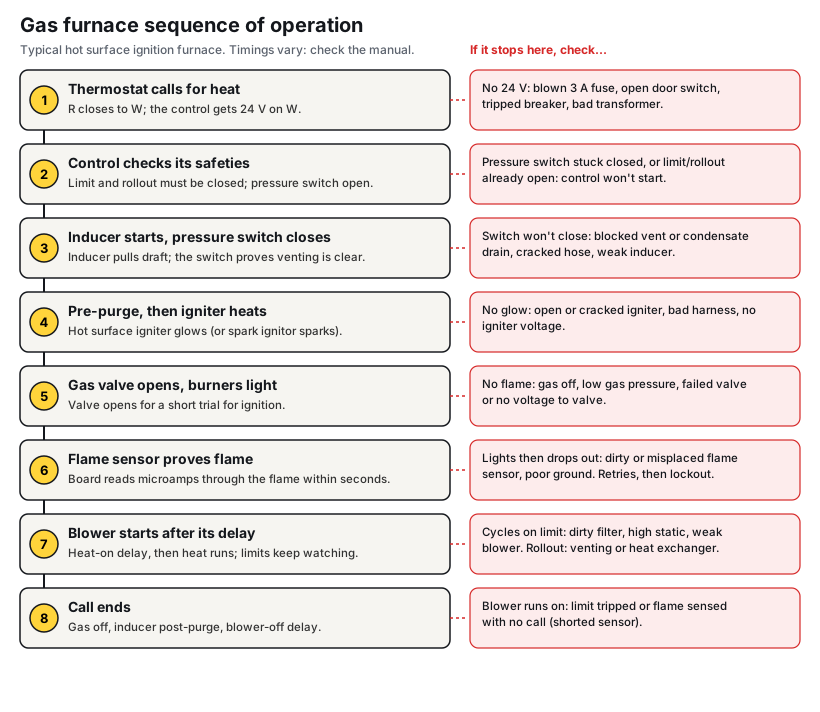
The ignition sequence
- Thermostat calls for heat (W).
- Inducer starts.
- Pressure switch closes.
- Igniter heats (hot surface) or sparks.
- Gas valve opens and burners light.
- Control proves flame through the flame sensor.
- Blower starts after a delay.
Where it stops tells you what to check
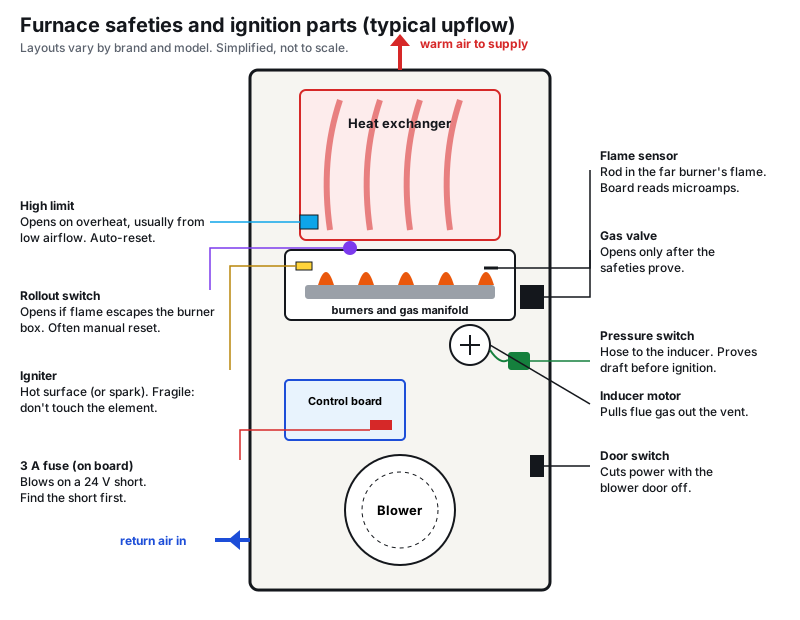
Stops before the igniter (no glow or spark): check the pressure switch, then the igniter. Measure the hot surface igniter's resistance against the manufacturer's spec and check for voltage to it during trial for ignition. Cracked or white-spotted igniters are common failures.
Igniter glows but no flame: confirm gas is on at the meter and appliance valve, check inlet and manifold pressure, and check for 24 VAC at the gas valve during ignition. Voltage present but no gas means a bad valve; no voltage points back to the control or a safety circuit.
Burners light, then go out after a few seconds: the control isn't proving flame. Clean the flame sensor and measure microamps, check the burner ground, confirm 120 VAC polarity (hot and neutral not reversed), and make sure the flame fully covers the sensor.
Lights fine but drops out later in the cycle: look at the pressure switch opening (vent, condensate trap, hoses) or a limit opening.
After the repair
Run several complete cycles and watch the flame. Check that the error code doesn't return.
How many tries before lockout
Most residential controls make three or four ignition trials. If none of them proves flame, the control locks out, usually for about an hour, then tries again. Some controls lock out for good until power is cycled. The exact count and timing are in the furnace's installation manual.
Clear a lockout by cycling power or the thermostat, then watch the next start from the beginning. A lockout you didn't see is just a code; one you watch tells you which step failed.
Readings that help
| Check | What to look for |
|---|---|
| Hot surface igniter resistance (cold) | Compare with the spec in the manual. Much higher than spec or OL means replace it. |
| Igniter voltage during warm-up | Line voltage (around 120 V) on most, or 80 V on some low-voltage designs. No voltage points to the board or the safety chain. |
| Gas valve voltage during trial | About 24 V AC across the valve terminals. Voltage but no gas means a failed valve or no gas supply. |
| Inlet gas pressure | Natural gas usually about 5–7 in. w.c. at the furnace inlet; LP higher. Use the rating plate and manual. |
| Manifold pressure | Set to the rating plate. Low manifold pressure gives a weak flame that may not reach the sensor. |
| Flame signal | Microamps DC through the flame sensor. Compare with the board's minimum in the manual. |
Intermittent lockouts
The hardest ones are the furnaces that light most of the time. Look for:
- A flame sensor right at the edge. It proves flame on a good day and misses on a cold, windy one. Clean it, check its position and the ground path.
- A cracked igniter that only fails when it's cold.
- Low gas pressure at peak times when other gas appliances run. Measure inlet pressure with the water heater and range on.
- Condensate backing up in a high-efficiency furnace, which opens the pressure switch mid-trial. Check the trap and drain.
- Wind and venting on sidewall-vented furnaces. Gusts can affect the pressure switch and flame.
Common mistakes
- Replacing the igniter or board without checking gas pressure. Low pressure causes weak flames and repeat lockouts.
- Sanding the flame sensor with coarse paper or steel wool. Use a fine abrasive pad or emery cloth and wipe it clean.
- Ignoring polarity and ground. Many boards won't prove flame if hot and neutral are reversed or the burner assembly isn't grounded.
- Forgetting the stored codes. Read the fault history before cycling power; some boards clear the active code at reset.
FAQ
How long does an ignition lockout last?
It varies by control. Many retry after about an hour. Cycling power or the thermostat usually resets it sooner.
Why does the furnace light on the second or third try?
A weak igniter, low gas pressure, or a marginal flame sensor can cause it. Measure rather than guess.
Sources
One field tip a week
A short, practical HVAC tip in your inbox every week: diagnostics, charging, airflow and code changes. Free, unsubscribe anytime.
We'll only use your email for the newsletter. Privacy policy.
Related guides
Furnace Blowing Cold Air: A Diagnostic Order That Finds It Fast
Why a gas furnace blows cold or lukewarm air, in the order to check it: thermostat fan setting, lockouts, flame proving, limits, gas supply, and duct leaks.
How to Test a Furnace Hot Surface Igniter (and Why They Keep Failing)
How to test a hot surface igniter by watching the sequence, checking voltage and measuring resistance, the difference between silicon carbide and silicon nitride igniters, and what shortens their life.
Furnace Flame Sensor: Microamp Readings, Cleaning and When to Replace
How flame rectification works, how to measure flame sensor microamps, what readings are normal, and how to fix weak flame signal.
How to Check Furnace Gas Pressure: Inlet and Manifold with a Manometer
Step by step for measuring furnace inlet and manifold gas pressure with a manometer, typical ranges for natural gas and propane, how to adjust, and how to clock the meter.
Field reference for trained technicians. Always follow the equipment manufacturer's instructions, local code and safe work practices. See our editorial standards, or report a correction.