Replacement Part Finder
Pick the part and enter what's printed on the old one. Add your meter readings to confirm it's really bad, then copy a one-line order for the supply house. For run capacitors, condenser fan and PSC blower motors, contactors and transformers it lists matching part numbers from the makers' catalogs (Titan Pro, MARS, Genteq, U.S. Motors, Packard, White-Rodgers).
- Capacitance
- Enter the µF printed on the old capacitor
- Voltage
- 370 V or 440 V (440 V can replace 370 V)
- Type
- Run capacitor (oil-filled, continuous duty), not a start capacitor
- Discharge it before testing or touching the terminals.
- Never install a lower voltage rating or a different µF, even "close enough."
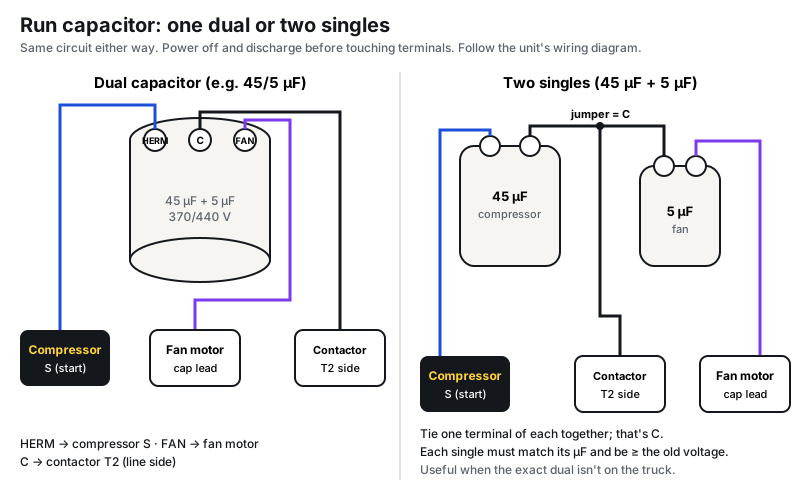
- Photograph the wiring; HERM goes to the compressor, FAN to the fan motor, C to the contactor.
- Find out why it failed: high head pressure (dirty condenser, failed fan), heat or high voltage.
How to use it
- Read the ratings off the old part or the unit's data plate before you leave for the supply house. Take a photo of the label and the wiring.
- Confirm the part is actually bad first: see testing a run capacitor, testing a contactor, testing a blower motor, testing a transformer and testing an igniter.
- Find out why it failed. A dirty condenser, low airflow or short cycling will kill the new part too.
How the tests are judged
- Capacitors: the measured µF must fall inside the tolerance printed on the label (±5%, ±6% or ±10%).
- Contactors: volts across a closed, loaded contact should be close to zero. Guidance varies; this tool flags anything over 0.5 V as worn and over 2 V as bad. Low coil voltage points upstream, not at the contactor.
- Motors: running amps more than 10% over the nameplate FLA get flagged. Check the capacitor, bearings and blade or wheel before condemning the motor.
- Transformers: R to C should read about 24 V under load. Low voltage usually means overload, the wrong primary tap or low line voltage.
Rules of thumb
- Capacitors: same µF, same or higher voltage. Two singles can replace a dual (see the capacitor wiring diagram). See picking a replacement capacitor or contactor.
- Motors: same HP, RPM, voltage and rotation; use the capacitor the new motor's label calls for. Condenser fan matches must have the same pole count (825, 1075 and 1625 RPM motors never swap), single speed, and a shaft at least as long as the old one. PSC blower matches also need at least as many speeds as the old motor. ECM blowers aren't matched: they need the OEM-programmed part.
- Contactors: same coil voltage and poles, amp rating at or above the load.
- Transformers: same primary, 24 V secondary, same or higher VA.
- Safeties: limits and rollouts must match temperature and reset type exactly. Never go higher.
When the equipment manufacturer specifies an OEM part, especially on variable-speed blowers, inverter equipment and silicon nitride igniters, use it.
One field tip a week
A short, practical HVAC tip in your inbox every week: diagnostics, charging, airflow and code changes. Free, unsubscribe anytime.
We'll only use your email for the newsletter. Privacy policy.
Related tools
HVAC Age by Serial Number
Pick the brand, enter the serial number, get the manufacture date and age.
UNITSHVAC Unit Converter
Tons, BTU/h and kW; °F and °C; psi, kPa and in. w.c.; CFM and L/s; oz, lb and kg.
SH/SCSuperheat & Subcooling Calculator
Enter your line temps and saturation temps; get superheat and subcooling instantly.
Results are estimates for field reference. Always confirm against the equipment manufacturer's charging chart, installation instructions and local code. Found a problem with this tool? Tell us.