How to Test an HVAC Transformer: 24-Volt Checks, VA Rating and Shorts
No 24 volts means no thermostat, no contactor, and no call for anything. The transformer is easy to test, but the real job is finding out why it failed.
Safety: The primary side carries line voltage. Use a meter rated for it, and turn the power off before disconnecting wires.
How the control circuit works
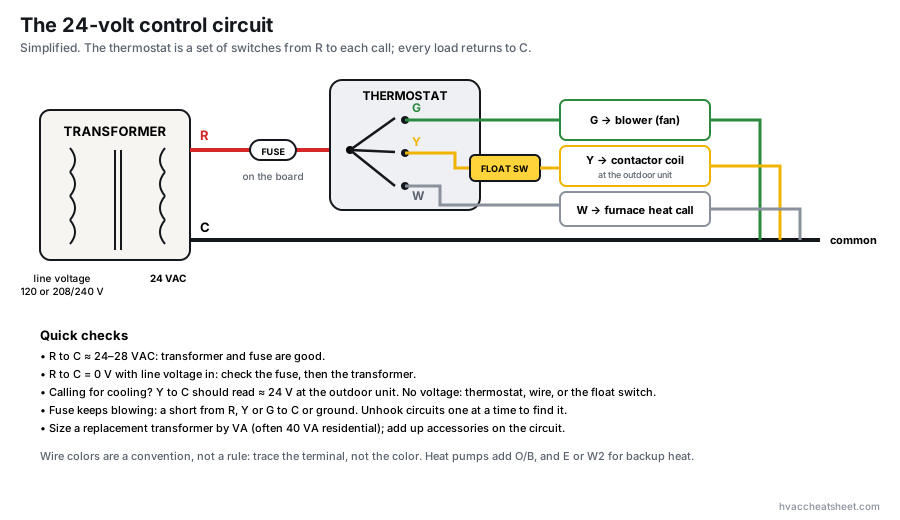
The transformer steps line voltage down to about 24 VAC. R is the hot side of the secondary and C is the common. The thermostat switches R to the other terminals (G, Y, W) to call for the fan, cooling or heat. Most residential transformers are rated around 40 VA; at 24 volts that's about 1.7 amps (VA ÷ volts).
Step by step
- Check the primary. With power on, measure across the primary leads. It should match the tap you're using (for example 120 V, or 208 V vs. 240 V on multi-tap units).
- Check the secondary. Measure between R and C at the board. Expect roughly 24–28 VAC with little load.
- Line voltage in, 0 volts out: check any fuse or circuit breaker on the secondary (many boards have a 3- or 5-amp fuse). If the fuse is good, the transformer is likely bad.
- Low secondary voltage under load: with the thermostat calling, measure R–C again. A big drop (well under 24 V) points to an overloaded or failing transformer, a wrong primary tap, or low line voltage.
- Check the transformer with power off if needed: an open winding (no continuity) on either side confirms failure.
Finding the short that killed it
A transformer or fuse that fails again usually means a short in the 24-volt wiring:
- Thermostat wire pinched by a panel, chewed, or nicked at a staple
- Outdoor unit wiring: the low-voltage wires at the condenser are a common short, especially on cut or rubbed wires near the base pan or a lawn trimmer's path
- Contactor coil shorted
- Float switch, humidifier, damper or other accessory wiring
- Miswired thermostat (R touching C)
Isolate it: disconnect the thermostat and outdoor wires at the board, power up, then reconnect one circuit at a time. See furnace control board fuse blown for a step-by-step approach.
Sizing a replacement
- Match the primary voltage and set the right tap.
- Match or exceed the VA rating. Add up the loads if accessories were added (zone panels, humidifiers, UV lights, dampers). Replacing a 40 VA with a 75 VA gives headroom where it's needed.
- Check the mounting and wiring: foot-mount, plate-mount, leads or screw terminals.
- Phase it correctly if the system has more than one transformer feeding shared circuits; follow the manufacturer's instructions.
Common mistakes
- Replacing the transformer without finding the short, then losing the new one.
- Using a smaller VA transformer than the original.
- Using the 240 V tap on a 208 V supply, which gives low secondary voltage.
- Putting a larger fuse in to stop it blowing. The fuse protects the transformer and board.
- Forgetting accessory loads on the transformer.
FAQ
What voltage should an HVAC transformer put out?
About 24 VAC nominal between R and C. Readings from about 24 to 28 volts are common with little load.
Why does my HVAC transformer keep burning out?
A short or an overload on the 24-volt side, most often damaged thermostat or outdoor wiring, a shorted contactor coil, or too many accessories.
Can I use a bigger transformer?
A higher VA rating with the same voltages is fine and adds headroom. Make sure the secondary fusing still protects the circuit.
Sources
One field tip a week
A short, practical HVAC tip in your inbox every week: diagnostics, charging, airflow and code changes. Free, unsubscribe anytime.
We'll only use your email for the newsletter. Privacy policy.
Related guides
Thermostat Blank or No Power: Finding the Missing 24 Volts
How to troubleshoot a blank thermostat: batteries, the C wire, the furnace door switch, a blown board fuse, a tripped float switch, the transformer and power to the air handler.
Furnace Control Board Fuse Blown (3A): Finding the 24V Short
Why a furnace control's low-voltage fuse blows and how to find the short in thermostat, outdoor unit or accessory wiring before replacing it.
How to Test a Blower Motor: PSC, Constant-Torque ECM and Variable-Speed ECM
How to tell which kind of blower motor you have and test it the right way, from capacitor and amp checks on PSC motors to control signals on constant-torque and variable-speed ECMs.
Replacing a Run Capacitor or Contactor: How to Pick the Right Part
How to choose a replacement run capacitor (µF, voltage, dual vs. single, size) and contactor (coil voltage, poles, amp rating), with the common mistakes that bring callbacks.
Field reference for trained technicians. Always follow the equipment manufacturer's instructions, local code and safe work practices. See our editorial standards, or report a correction.