How to Test a Blower Motor: PSC, Constant-Torque ECM and Variable-Speed ECM
A blower that won't run, runs slow or runs all the time can be the motor, the capacitor, the board, or the signal the board sends. The test depends on which motor is in the cabinet.
Safety: Turn off power before unplugging connectors or touching the capacitor. Discharge the capacitor before handling. ECM modules hold a charge too; wait a few minutes after power-off before unplugging the power connector.
Which motor is it?
| Motor | How to recognize it | How it's told to run |
|---|---|---|
| PSC (permanent split capacitor) | Run capacitor on the housing or nearby; several colored speed leads (black, blue, red, etc.), unused ones parked on dummy terminals | Line voltage to one speed lead at a time |
| Constant-torque ECM ("X13" style) | No capacitor; a line voltage plug plus a row of numbered tap terminals (often 1–5) | Line voltage always present; 24 VAC on a tap picks the speed |
| Variable-speed ECM | Electronic module on the back of the motor; a 5-pin power plug and a 16-pin control plug | Line voltage always present; the board sends commands on the 16-pin harness |
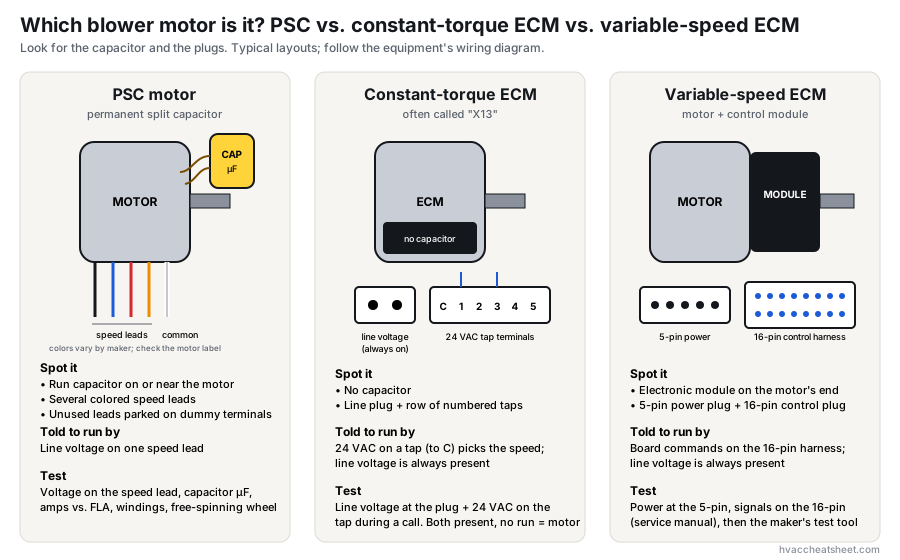
Testing a PSC motor
- Check the call. With the board calling for the blower, measure line voltage between the speed lead in use and neutral (or L2 on 240-volt motors). No voltage means a board, relay or wiring problem, not the motor.
- Test the run capacitor with a meter under load or out of circuit, and compare it to the rated µF and tolerance. A weak capacitor makes the motor run slow, hot or not start. See how to test a run capacitor and use the capacitor check calculator.
- Spin the wheel by hand with power off. It should turn freely and coast. Tight or noisy bearings, or a wheel rubbing the housing, point to mechanical failure.
- Measure amps while running and compare with the nameplate full-load amps (FLA). Higher than FLA with a good capacitor and clean wheel points to a failing motor or a wheel/belt problem; well below FLA with low airflow often points to a clogged wheel or very high static pressure.
- Check windings with power off: measure resistance between the common lead and each speed lead. An open winding (no continuity) on the speed in use means the motor is bad. Any reading to the motor frame (ground) means it's shorted.
- Feel for heat. A motor that trips on its internal overload will stop, cool, then restart.
Testing a constant-torque ECM
- Check line voltage at the motor's power plug. It should be present whenever the unit has power.
- Check the tap signal: with a call for the blower, measure 24 VAC between the energized tap terminal and the common (C) terminal at the motor.
- Line voltage and a 24-volt signal but no run: with power off, unplug and reconnect the plugs to check the pins, then retest. If it still doesn't run with both present, the motor is likely bad.
- No 24-volt signal: the problem is upstream: the board, thermostat call or wiring.
- Runs on the wrong speed: check which tap is wired for heat and which for cooling, and whether more than one tap is energized at the same time.
Testing a variable-speed ECM
- Check line voltage at the 5-pin power plug.
- Check the board's commands: with a call, check the 24 VAC signals on the 16-pin harness the manufacturer's service manual lists (such as the fan, cool, heat and Y signals).
- Use the manufacturer's test tool or procedure if available. Many manufacturers and motor makers have a test that runs the motor directly to see whether the motor or the board is at fault.
- Replacing just the module is an option on some motors; the replacement module usually has to be programmed for that specific equipment.
- Check for water damage. Condensate leaking onto the motor or module is a common cause of ECM failures, so fix the drain at the same time.
Readings that point to the cause
| Symptom | Likely cause |
|---|---|
| PSC hums, won't start, starts if spun by hand | Weak or failed run capacitor |
| PSC runs slow and hot | Weak capacitor, failing bearings, wrong speed tap |
| ECM never runs, line voltage present, signal present | Failed motor or module |
| ECM never runs, no signal | Board, thermostat or wiring |
| Blower runs constantly | Fan switch set to ON, stuck relay on the board, or a constant-fan setting |
| Low airflow, motor fine | Dirty blower wheel, filter, coil, or high static |
Common mistakes
- Replacing a PSC motor without testing the capacitor.
- Condemning an ECM without checking for the 24-volt or control signal.
- Putting a universal motor on the wrong speed tap, which causes high temperature rise or a frozen coil. Set speeds for heating and cooling airflow, then check them.
- Not cleaning the blower wheel. A caked wheel moves far less air even with a new motor.
- Not checking temperature rise and static pressure after the repair. See furnace temperature rise.
FAQ
Can I replace an ECM blower motor with a PSC motor?
Conversion kits exist, but they change airflow, efficiency and sometimes the equipment's rating. Follow the manufacturer's guidance; on many systems the right fix is the matching ECM or module.
Why does my blower motor hum but not spin?
On PSC motors, a bad capacitor or seized bearings are the usual causes. Test the capacitor and spin the wheel by hand with the power off.
How long do blower motors last?
It varies widely. Dirt, heat, water and failed capacitors shorten their life the most.
Sources
One field tip a week
A short, practical HVAC tip in your inbox every week: diagnostics, charging, airflow and code changes. Free, unsubscribe anytime.
We'll only use your email for the newsletter. Privacy policy.
Tools for this job
Related guides
How to Test an HVAC Transformer: 24-Volt Checks, VA Rating and Shorts
How to test the 24-volt control transformer in a furnace or air handler, how to size a replacement by VA, and how to find the short that killed the last one.
How to Test a Run Capacitor: Meter Method and Under-Load Method
Test HVAC run capacitors two ways, with the meter's capacitance setting and under load with amps × 2652 ÷ volts, and know when to replace one.
Replacing a Run Capacitor or Contactor: How to Pick the Right Part
How to choose a replacement run capacitor (µF, voltage, dual vs. single, size) and contactor (coil voltage, poles, amp rating), with the common mistakes that bring callbacks.
Belt-Drive Blowers: Belt Tension, Pulley Alignment, Bearings and Setting Airflow
How to service a belt-drive blower on older furnaces, air handlers and rooftop units, including belt tension and alignment, bearings, adjustable pulleys and how they change airflow.
Field reference for trained technicians. Always follow the equipment manufacturer's instructions, local code and safe work practices. See our editorial standards, or report a correction.