How to Replace a Condenser Fan Motor: Matching, Rotation, Wiring and Blade Height
Most condenser fan motor swaps go wrong in one of three places: the wrong RPM, the wrong rotation, or a blade set at the wrong height. All three are easy to get right if you check them before the old motor comes out.
Safety: Turn off power at the panel and pull the outdoor disconnect, then prove it dead with a meter. Discharge the capacitor before touching its terminals.
Read the old motor before you buy
Write down everything on the old motor's label, or photograph it. You need:
| Spec | What has to match |
|---|---|
| Horsepower | The same HP. A multi-HP motor is fine if its range covers the old HP. |
| RPM | The same nameplate speed: 825, 1075 (1100 on some labels) or 1625. These are different pole counts and never swap. |
| Voltage | 208–230 V or 460 V (some units use 115 V). |
| Speeds | Single-speed for a single-speed motor. |
| Frame and diameter | Most residential condensers use a 5.6" (48 frame) motor; some use 5" (42 frame). |
| Shaft | Diameter (usually 1/2") and length from the motor face. The new shaft should be at least as long. |
| Mounting | Studs, through-bolts, belly band, or OEM-specific holes. |
| Rotation | CW or CCW, and whether the label means shaft end or lead end. |
The replacement part finder checks these for you: enter HP, RPM, voltage and shaft length and it lists matching U.S. Motors and MARS catalog motors with their shaft length, mounting style and the capacitor each one needs.
An OEM motor is the closest fit because it's built for that unit's blade and shroud. Universal replacements work well when the specs match, but they usually come with a longer shaft and extra mounting options you'll need to adapt.
Rotation: shaft end vs. lead end
Rotation on a motor label is read from one end or the other. A motor marked CWLE turns clockwise when you look at it from the lead end; CWSE means clockwise from the shaft end. The same motor reads the opposite way from the other end, so CWLE is the same as CCWSE.
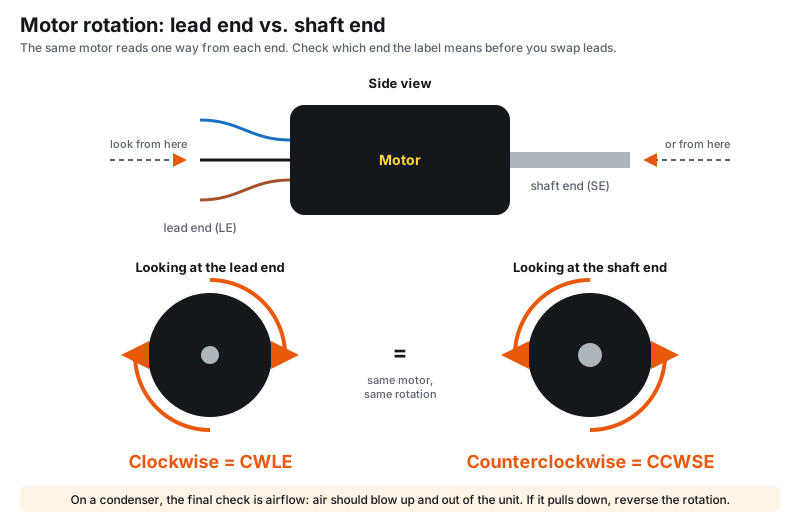
Most universal condenser fan motors are reversible: you swap the reversing leads to change direction. Whatever the label says, the test that counts is airflow. Air should blow up and out of the top of the unit, not get pulled down through it.
Step by step
- Kill power and prove it dead. Pull the disconnect and check with a meter.
- Photograph the wiring at the contactor (or the defrost board on a heat pump) and the capacitor.
- Discharge the capacitor, then disconnect the motor leads.
- Mark the blade position. Measure from the blade hub to the end of the shaft, or mark the shaft, before you loosen the set screw. This is how you set the new blade at the same height in the shroud.
- Pull the fan grille and motor. Note how the leads and conduit enter the motor so you can route the new one the same way.
- Inspect the blade. A blade with a bent or cracked arm will shake the new motor apart. Replace it with one of the same diameter, blade count and pitch.
- Prepare the new motor. Remove the drain plugs from the end shield that will point down (the shaft end on a shaft-down condenser). Remove any mounting studs or brackets you won't use.
- Mount the motor and blade. Set the blade at the same position you marked. Tighten the set screw on the shaft flat; snug is enough.
- Wire it (single-speed PSC):
- Black (line) to L1 on the contactor, or to the defrost board's L1 terminal on a heat pump
- White or yellow (common) to C on the capacitor, or L2 on the contactor
- Brown to FAN on the capacitor
- On a four-wire universal motor, the brown-with-white-stripe lead is capped and not used
- Set rotation. If it's reversible, set it before you close up and confirm with airflow at startup.
- Install a new capacitor rated for the new motor (its label gives the µF). If the old fan capacitor was half of a dual, the new dual must still match the compressor side.
- Start it and check amps. Air should move up and out, and running amps should be within 10% of the new motor's nameplate.
Common mistakes
- Buying by HP alone. A 1/4 HP 825 RPM motor on a blade designed for 1075 RPM moves far less air and runs head pressure up.
- Reading rotation from the wrong end. Confirm whether the label means lead end or shaft end before you swap leads.
- Reusing the old capacitor. A weak capacitor is a common reason fan motors fail in the first place.
- Setting the blade by eye. Too high or too low in the shroud cuts airflow; use the mark you made.
- Leaving drain plugs in. Water that can't drain out of the low end shield ruins bearings.
- Leads in the blade's path. Tie the reversing leads and any unused lead back so they can't reach the blade.
Why did it fail?
Replace the motor, then look at why it died. Condenser fan motors usually fail from worn bearings, a bad capacitor, or heat. Check the capacitor and the contactor, clean the condenser coil, and if the fan wasn't spinning at all, see condenser fan not spinning for the full diagnosis.
FAQ
Can I use a 1075 RPM motor to replace an 1100 RPM motor?
Yes. Both are 6-pole motors; 1100 is just how some labels round the same speed. What you can't do is swap between 825 (8-pole), 1075 (6-pole) and 1625 (4-pole) motors.
What does CCWLE mean on a condenser fan motor?
Counterclockwise looking at the lead end of the motor. From the shaft end, that same motor turns clockwise.
Do I need a new capacitor with a new fan motor?
Use the capacitor rating printed on the new motor's label, and replace the capacitor at the same time. Universal motors can call for a different µF than the original.
The new motor's shaft is much longer. Is that a problem?
Usually not. Universal motors come with long shafts so they fit more units. Set the blade at the original height; if the extra shaft hits the grille or guard, cut it back.
How do I know the fan is turning the right way?
Hold your hand over the top of the unit at startup. On a typical top-discharge condenser, air should blow up and out. If it's pulling down, reverse the rotation.
Sources
- David Starich, "How to Safely and Accurately Replace a Condenser Fan Motor," ACHR News (Aug. 15, 2023)
- ACHR News, "Replacing Refrigeration Fan Motors" (CWLE / CWSE rotation)
- HVAC School, "How to Replace a Condensing Fan Motor"
- U.S. Motors (Nidec) condenser fan motor catalog pages, pp. 143–144
- MARS catalog 98605, p. M-6, outdoor condenser fan motors
One field tip a week
A short, practical HVAC tip in your inbox every week: diagnostics, charging, airflow and code changes. Free, unsubscribe anytime.
We'll only use your email for the newsletter. Privacy policy.
Tools for this job
Related guides
Condenser Fan Not Spinning: Capacitor, Motor or Control?
Find out why an outdoor condenser fan won't run, from the fan capacitor and seized bearings to the contactor, wiring and heat pump defrost.
AC Outdoor Unit Humming but Not Running: Capacitor, Contactor, Fan Motor or Compressor?
What a hum from the outdoor unit tells you, and the order to check it in. Sort out whether the fan, the compressor or both are stuck, then test the capacitor, contactor, fan motor and compressor before replacing anything.
Replacing a Run Capacitor or Contactor: How to Pick the Right Part
How to choose a replacement run capacitor (µF, voltage, dual vs. single, size) and contactor (coil voltage, poles, amp rating), with the common mistakes that bring callbacks.
AC Breaker Keeps Tripping: How to Find Out Why
How to diagnose an air conditioner or heat pump that keeps tripping its breaker: a grounded compressor, a locked rotor, a shorted fan motor, wiring faults, high head pressure or a weak breaker.
Field reference for trained technicians. Always follow the equipment manufacturer's instructions, local code and safe work practices. See our editorial standards, or report a correction.