Condensate Float Switches: Code Requirements, Wiring and Troubleshooting
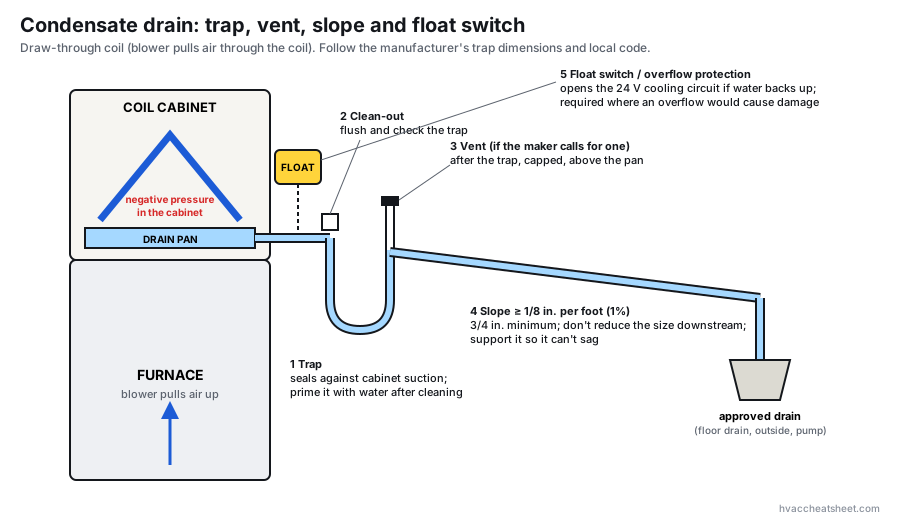
A clogged condensate drain is one of the most common causes of ceiling damage. A float switch (water-level detection device) shuts the equipment off before the pan overflows. It's also a common reason an AC "won't come on."
What the code requires
The IRC (section M1411.3.1) applies where an overflow from the cooling coil drain would damage building components, such as attics and above finished ceilings. It gives several ways to comply, including:
- A separate overflow (secondary) drain connected to the equipment's drain pan, discharging to a conspicuous point so occupants notice it.
- An auxiliary drain pan with its own drain line under the coil.
- An auxiliary pan without a drain line, equipped with a water-level detection device conforming to UL 508 that shuts off the equipment before the pan overflows.
- A water-level detection device installed in the primary drain line, the overflow drain line or the equipment drain pan, above the primary drain connection and below the pan's overflow rim.
Drain piping must be at least 3/4 in. Some jurisdictions add their own rules, so check locally.
Types of float switch
| Type | Where it goes | Notes |
|---|---|---|
| Inline (in the primary drain) | On the drain line near the unit | Catches a clog downstream. RectorSeal's SS1 is an example: a float in a tee, rated 24 VAC, 1.25 A max. |
| Primary pan outlet | Threaded into the secondary outlet of the primary pan | Common on air handlers with a secondary port |
| Auxiliary pan | Sits in the pan under the unit | The last line of defense; also catches a leaking coil or pan |
| Electronic / probe | Pan or drain | Some mini-split switches wire to the unit's own shutoff terminals |
Wiring: R or Y
Most 24 V float switches are normally closed and open when water lifts the float. You choose which wire to break:
- Break R (24 V to the thermostat): shuts down everything. On many thermostats, the screen goes blank, which is often how the homeowner notices. See thermostat blank.
- Break Y (compressor call): stops cooling but lets the blower keep running. RectorSeal notes this keeps the fan running to help with mold during long absences.
Rules of thumb:
- Read the switch instructions. RectorSeal's SS1 is for Class 2 (thermostat) circuits only and says not to use it on dual-compressor systems.
- On heat pumps and communicating systems, breaking R can kill heat too, and breaking Y alone may not stop the right things. Follow the equipment and switch instructions.
- On ductless units, use the switch made for that brand's shutoff terminals rather than cutting communication wires.
- Multiple switches on one system are wired in series so any one of them shuts it down.
Testing a float switch
- Lift test: with the unit running, lift the float (or push the test lever). If it's wired correctly, the unit stops. RectorSeal's instructions call for this test after installing.
- Fill test: plug the drain downstream and let the pan fill (or pour water). The switch should trip before water reaches the overflow rim.
- Reset: once the water drains, the switch should close and the system should restart, sometimes after a board delay.
When the AC won't come on
If the thermostat is blank or the outdoor unit won't start on a call for cooling:
- Look in the primary and auxiliary pans for water.
- Check the float switch: is it tripped? Is the float stuck up from slime or debris?
- Clear the drain (wet vac at the outdoor end, flush with water), clean the trap, and make sure it slopes properly.
- Check that the switch resets. A switch that stays open with no water is bad.
- Never jumper a float switch out to get the system running and leave it. Fix the drain, then put the safety back in service.
If the float switch is closed and the outdoor unit still won't start, follow the 24 V outdoors: see outside AC unit not running but inside is.
For why condensate overflows in the first place (clogged trap, missing vent, a cracked pan, a frozen coil melting), see AC leaking water inside.
FAQ
Does code require a float switch on an AC?
Where an overflow would cause damage, the IRC requires one of several protections: a secondary drain, an auxiliary pan, or a UL 508 water-level device that shuts off the equipment. A float switch is one way to comply.
Should a float switch break the red or yellow wire?
Breaking R shuts off the whole system; breaking Y stops cooling but lets the fan run. Follow the switch and equipment instructions, especially on heat pumps and communicating systems.
Why is my thermostat blank and the AC off?
A tripped float switch in the R circuit cuts power to the thermostat. Check the drain pan and switch before chasing the transformer.
Can a float switch go bad?
Yes. Floats stick in slime, and switches fail open or closed. Lift-test it at every maintenance visit.
Sources
One field tip a week
A short, practical HVAC tip in your inbox every week: diagnostics, charging, airflow and code changes. Free, unsubscribe anytime.
We'll only use your email for the newsletter. Privacy policy.
Related guides
Outside AC Unit Not Running but Inside Is: Follow the 24 Volts
When the indoor blower runs on a cooling call but the condenser sits silent, the fault is almost always in the 24-volt path to the contactor coil or in the line-voltage supply. How to trace it, from the thermostat and float switch to pressure switches, time delays and the disconnect.
Thermostat Blank or No Power: Finding the Missing 24 Volts
How to troubleshoot a blank thermostat: batteries, the C wire, the furnace door switch, a blown board fuse, a tripped float switch, the transformer and power to the air handler.
AC Leaking Water Inside: Condensate Drain, Float Switch and Pan Problems
Why an air handler or furnace coil leaks water indoors, how to find the cause fast, and how to clear and protect the condensate drain so it doesn't come back.
AC Short Cycling: Why the Compressor Turns On and Off Too Often
How to diagnose an air conditioner or heat pump that short cycles, using how long it runs and what stops it: thermostat problems, safety switches, low charge, airflow, and oversizing.
Field reference for trained technicians. Always follow the equipment manufacturer's instructions, local code and safe work practices. See our editorial standards, or report a correction.