AC Leaking Water Inside: Condensate Drain, Float Switch and Pan Problems
An air conditioner pulls a lot of water out of the air on a humid day, and all of it has to leave through the condensate drain. When water shows up on the floor, ceiling or furnace, something between the coil and the drain's end point has failed.
Safety: Shut off power before opening the cabinet. Water near a furnace, air handler wiring or a condensate pump outlet is a shock hazard. If the ceiling is stained or sagging under an attic unit, shut the system off and protect the room below first.
Start with where the water is
| Where the water is | Most likely cause |
|---|---|
| Pouring from the secondary drain (often over a window) | Primary drain clogged; the secondary is doing its job |
| Water in the auxiliary pan under an attic unit | Primary drain clogged or the primary pan is cracked |
| Water inside the furnace or on top of it | Coil pan overflowing, or a coil drain connection leaking |
| Water around the base of a furnace in heat mode | High-efficiency furnace condensate (see below), not the AC |
| Ice on the suction line or coil, water after shutdown | Frozen coil thawing |
| System off and the thermostat blank or not calling | Float switch tripped by a backed-up drain |
| Water around a condensate pump | Pump failed, float stuck, or the discharge line is blocked |
Step by step
- Check whether the system is running. Many systems have a float switch in the pan or drain line that opens the 24-volt circuit when water rises. A tripped float looks like "AC not working" more often than "water leak."
- Look for ice. If the coil or suction line is frozen, turn cooling off and run the fan to thaw it, then fix the cause. See frozen evaporator coil causes.
- Find the primary drain where it leaves the coil pan and follow it to where it ends (a floor drain, a pump, outside, or a plumbing connection).
- Clear the blockage. Use a wet/dry vacuum on the outside end, or blow it clear with nitrogen or compressed air from the coil end while someone watches the outlet. Remove the cap or clean-out at the trap and flush with water.
- Clean the pan and trap. Slime (biological growth) in the pan and trap is the usual source of clogs. Clear it, then flush until water runs freely.
- Pour water into the pan and watch it leave the drain end at a steady flow. If it backs up, the clog is still there or the line doesn't have enough slope.
- Test the float switch. Lift the float or fill the pan until it trips, and confirm the system shuts off. Reset it and confirm the system restarts.
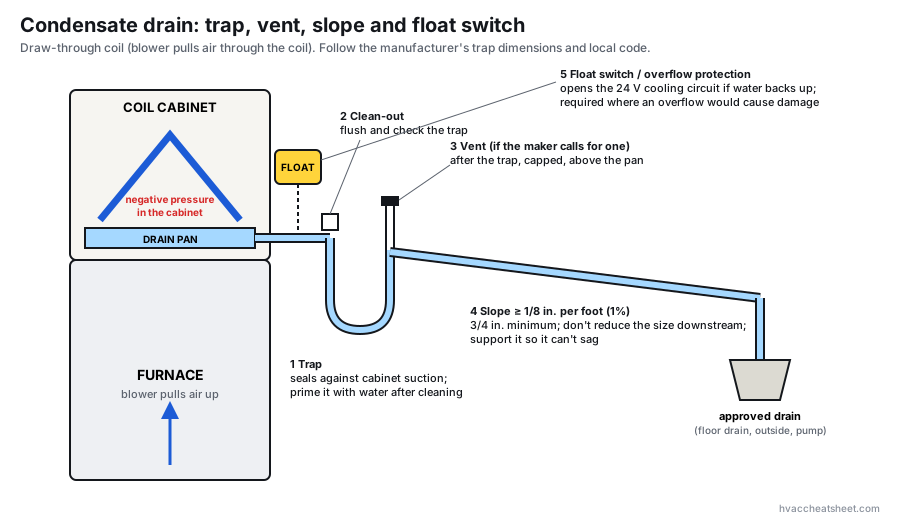
Traps and why they matter
On many air handlers and furnace coils, the blower pulls air through the coil (draw-through), so the drain pan is under negative pressure. Without a proper trap, the blower pulls air in through the drain line and holds the water in the pan until it overflows, even though the line is clear.
- Follow the manufacturer's trap instructions for depth. A trap that's too shallow can be sucked dry; one that's too deep can hold water back.
- Prime the trap with water after cleaning so it seals right away.
- Look for a vent after the trap where the manufacturer calls for one, and make sure it has a cap.
- Don't add a second trap in series; double-trapped lines hold water and gurgle.
Drain line slope and size
Residential codes generally require a primary condensate drain of at least 3/4-inch nominal size, pitched toward the drain at not less than 1/8 inch per foot. Many installers use 1/4 inch per foot where they can, because a line with barely any slope fills with slime and sags between supports.
Look for:
- Sags between hangers where water sits
- Long horizontal runs with no clean-out
- A reduced size after the pan connection (codes don't allow the line to get smaller downstream)
- Lines tied into a plumbing drain without an air gap or trap where your local code requires one
Overflow protection
Where an overflow would damage the building (an attic, a closet over finished space), codes require a backup: an auxiliary pan with its own drain, a secondary drain from the primary pan, or a water-level switch that shuts the system off. If an attic unit has an auxiliary pan with water in it and no float switch, recommend one.
Condensate pumps
- Check the pump runs when you pour water into its reservoir.
- Clean the reservoir and check valve; slime sticks the float and the valve.
- Check the discharge line for kinks and blockages, especially where it runs through an attic or exits outside.
- Wire the pump's safety switch to stop cooling if the pump fails, where the pump has one.
High-efficiency furnace condensate
A 90%+ furnace makes its own condensate in heating mode, from the secondary heat exchanger and vent. If water shows up in winter, check the furnace's trap, drain hoses and vent drain, and the pressure switch, which can trip when the trap is blocked.
Keeping it from coming back
- Flush the drain at every maintenance visit and clean the trap. Add it to your AC maintenance checklist.
- Use drain pan tablets if the manufacturer allows them, to slow slime growth.
- Fix low airflow and charge problems that freeze the coil.
- Add a clean-out tee at the trap so the next tech can flush it in a minute.
Common mistakes
- Clearing the clog and leaving. Slime grows back. Clean the pan and trap too, and recommend regular flushing.
- Using strong chemicals that damage the pan, coil or PVC. Use cleaners the manufacturer approves.
- Jumping out the float switch to get cooling back. It's the only thing protecting the ceiling.
- Missing a frozen coil. Water after shutdown on a hot day often means the coil was frozen; the drain may be fine.
- Ignoring a dry trap. On draw-through systems, the trap matters as much as a clear line.
FAQ
Why is my AC leaking water but still cooling?
The drain is usually partly clogged or the trap is wrong, so some water overflows the pan while the system keeps running. Clear and flush the drain, then check the trap.
Is it safe to run the AC with a leak?
Not for long. Water damages ceilings, floors and electrical parts. Turn the system off until the drain is cleared, unless the water is going safely into an auxiliary pan with a working float switch.
Why does the AC drip water only at night or on humid days?
That's when it removes the most moisture. A drain that barely keeps up on a dry day can overflow on a humid one.
Sources
One field tip a week
A short, practical HVAC tip in your inbox every week: diagnostics, charging, airflow and code changes. Free, unsubscribe anytime.
We'll only use your email for the newsletter. Privacy policy.
Related guides
Frozen Evaporator Coil: Causes, Safe Thawing and What to Check
Why AC evaporator coils freeze, how to thaw one safely, and the order to check airflow, charge and metering once it's thawed.
AC Short Cycling: Why the Compressor Turns On and Off Too Often
How to diagnose an air conditioner or heat pump that short cycles, using how long it runs and what stops it: thermostat problems, safety switches, low charge, airflow, and oversizing.
AC Not Cooling? A Step-by-Step Diagnostic Checklist for Techs
Work an AC no-cool call in the right order, from the thermostat call to airflow, electrical and refrigerant charge, without guessing.
Thermostat Blank or No Power: Finding the Missing 24 Volts
How to troubleshoot a blank thermostat: batteries, the C wire, the furnace door switch, a blown board fuse, a tripped float switch, the transformer and power to the air handler.
Field reference for trained technicians. Always follow the equipment manufacturer's instructions, local code and safe work practices. See our editorial standards, or report a correction.